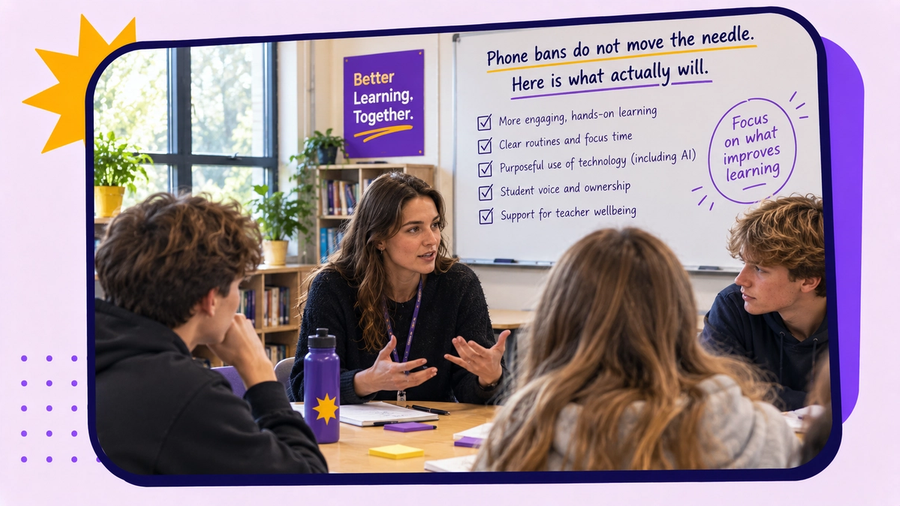
Phone bans do not move the needle. Here is what actually will.
10-second summary
Nearly 5,000 US schools locked phones away and test scores, attendance, attention and online bullying were all unchanged — while disciplinary incidents rose. Removing a distraction is not the same as creating learning, and the structural problem was never in students' pockets.
5,000 schools banned phones. Scores didn't move.
A new NBER working paper from Allcott, Dee, Duckworth and colleagues analyzed lockable phone pouches across nearly 5,000 U.S. schools — the largest quasi-experimental study of phone bans ever conducted in the country. The results are uncomfortable for everyone who treated phones as the headline villain of the learning crisis.
- Average effect on test scores: zero.
- No measurable improvement in attendance.
- No change in classroom attention.
- No reduction in online bullying.
- Disciplinary incidents actually went up.
Legislators passed bans. Districts spent budgets on pouches. Parents cheered. And the needle didn't move.
Removing a distraction is not the same as creating learning
Phones are distracting. That part is true. But "less distraction" and "more learning" are not the same equation. You can confiscate every device in every classroom and students will still sit through content they've already mastered, or content they aren't ready for. Teachers will still be held to pacing guides instead of student progress. Outcomes will stay exactly where they are.
The phone ban solved for optics, not for learning.
The problem was never in students' pockets
The deeper issue is structural. In most schools, time is the constant and learning is the variable. A unit gets a fixed number of weeks, and every student is moved through it on the same clock — regardless of whether they understood lesson three or whether they could have skipped lessons one and two entirely.
Add to that a generation of kids who are anxious, lonely, and struggling to regulate emotions in real time, and the picture gets clearer. Phones aren't the disease. They're the most convenient symptom to treat.
What actually moves outcomes
If we're serious about student outcomes, the conversation has to shift from "ban screens" to two harder questions:
1. What is a meaningful use of screen time?
A phone or tablet that delivers a personalized math problem at the right difficulty, gives instant feedback, and adapts when a student gets stuck is doing something a 30-student classroom physically cannot. A phone scrolling TikTok in a back pocket is not. The difference isn't the device — it's the intent behind the minute.
Schools that win with technology don't ban it. They use it where it actually outperforms the analog alternative — practice, feedback, repetition, accessibility — and put it down everywhere else.
2. What are we not teaching that matters most?
The skills that quietly determine whether a kid thrives are almost never on the test:
- Conflict resolution — being able to disagree without shutting down or escalating.
- Emotional regulation — naming what you feel before you act on it.
- Listening — hearing what someone actually said, not what you assumed they meant.
- Collaboration — getting work done with people you didn't choose.
- Self-direction — deciding what to learn next when no one tells you to.
These are the things employers, partners, and communities select for. They're also the things a phone ban cannot teach and a worksheet cannot measure.
Listening to kids is part of the curriculum
There's a quieter finding inside the disciplinary uptick: when adults remove something kids rely on without asking why they rely on it, friction goes up. Many students use phones to manage anxiety, coordinate with family, or just get a moment of psychological space inside an environment they find overwhelming. Take that away with no replacement and behavior gets worse, not better.
Real reform starts with asking students — actually asking — what's working, what isn't, and what they need. Most schools have never run that survey, let alone acted on it.
What a better school day looks like
It's not screens-on or screens-off. It's:
- Screens used intentionally — for personalized practice, accessibility, and feedback that a teacher of 30 can't deliver in real time.
- Screens put away — during the parts of the day designed for human contact: discussion, debate, collaboration, restorative conversations, mentorship.
- Soft skills taught explicitly — not as a poster on the wall, but as a curriculum with time, language, and assessment behind it.
- Pacing tied to mastery, not the calendar — students move on when they're ready, not when the syllabus says so.
- Student voice built in — surveys, advisory groups, and feedback loops that actually change how the school operates.
Phones were never going to fix that, and banning them was never going to fix that. The work is harder, slower, and less photogenic than a wall of pouches. It's also the work that actually moves outcomes.
Repost this if you're tired of policies that look decisive on a press release and change nothing in the classroom.
Frequently asked questions
Do phone bans in schools improve test scores?
Not according to the largest quasi-experimental study of them conducted in the US. An NBER working paper from Allcott, Dee, Duckworth and colleagues analysed lockable phone pouches across nearly 5,000 schools and found an average effect on test scores of zero, no measurable improvement in attendance, no change in classroom attention and no reduction in online bullying.
Why did disciplinary incidents go up rather than down?
When adults remove something students rely on without asking why they rely on it, friction increases. Many students use phones to manage anxiety, coordinate with family, or get a moment of psychological space in an environment they find overwhelming. Removing that with no replacement tends to make behaviour worse, not better.
If phones aren't the problem, what is?
The structure of the school day. In most schools time is the constant and learning is the variable: a unit gets a fixed number of weeks and every student moves through it on the same clock, whether or not they understood lesson three or could have skipped lessons one and two. Confiscating devices does not change that.
What counts as meaningful screen time?
A device that delivers a personalised problem at the right difficulty, gives instant feedback and adapts when a student gets stuck is doing something a thirty-student classroom physically cannot. A phone scrolling in a back pocket is not. The difference is not the device but the intent behind the minute.
Which soft skills matter most, and can schools actually teach them?
Conflict resolution, emotional regulation, listening, collaboration and self-direction — the skills employers and communities select for and that no test measures. They can be taught, but only as a curriculum with time, language and assessment behind it, rather than as a poster on the wall.