Why homework fails most kids and how personalized learning can fix it
10-second summary
Homework fails so many students not because they are lazy, but because one worksheet is written for a class rather than for a child. When practice connects to something a student already cares about, attention follows — and technology now makes that personalisation possible at a scale a single teacher never could.
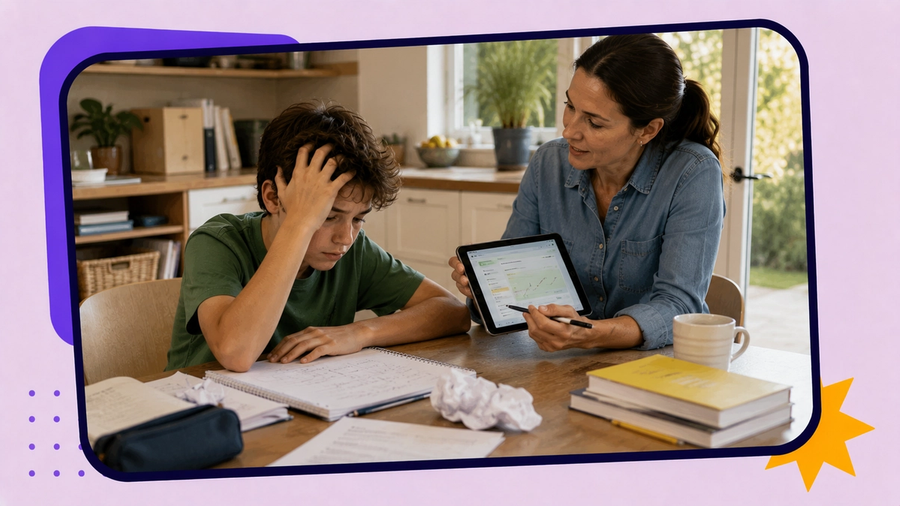
For many children, homework feels like a chore. The typical experience is a worksheet filled with repetitive questions that must be completed the same way by every student. There is little connection to the child’s interests, curiosity, or real life. The result is predictable. Students become disengaged, bored, and often frustrated.
This problem is not new. Traditional homework has long focused on standardized exercises designed for efficiency rather than engagement. While this approach can help reinforce basic skills, it often ignores one critical factor in learning: motivation.
The Problem With One-Size-Fits-All Homework
Most homework systems follow a simple formula. A teacher introduces a topic in class and assigns a worksheet to practice the concept. Every student receives the same set of problems regardless of their interests, learning style, or level of curiosity about the topic.
For some students, this works. But for many others, it does not.
Children naturally learn better when they feel connected to the material. When a topic relates to something they already care about, their brain becomes more receptive. The difference between solving ten random math problems and calculating statistics related to a favorite sport can be dramatic.
In the first case, the task feels mechanical. In the second, it feels meaningful.
Unfortunately, traditional systems rarely have the flexibility to personalize homework for every child.
When Teachers Connect Learning to Interests
Most people can remember at least one teacher who made learning feel different.
These teachers connected lessons to things students already cared about. A math problem might involve football scores. A physics example might relate to skateboarding tricks. A writing assignment might revolve around a student's favorite hobby.
Suddenly the same concepts felt easier to understand.
This happens because interest acts as a gateway to attention. When students care about the context, they naturally invest more effort in solving the problem.
The challenge is scale. A single teacher can personalize learning for a classroom only to a limited degree. Doing this for every individual student consistently is extremely difficult.
A Different Approach to Homework
A new generation of educational platforms is trying to solve this problem by starting from a different place: the student’s interests.
Instead of giving every learner the same exercise, the process begins with a simple question:
What does the child care about?
It could be sports, animals, space, music, technology, or hundreds of other topics.
Once an interest is selected, the learning content adapts. Exercises, challenges, and even small games are generated around that interest while still teaching the same academic concepts.
A multiplication problem might involve football players. A reading exercise might involve space exploration. A logic puzzle might revolve around building robots.
The academic goal remains the same, but the context becomes personal.
Turning Learning Into Interactive Games
Another challenge with traditional homework is the format. Static worksheets rarely feel exciting.
Modern learning tools are experimenting with interactive exercises and simple educational games that transform practice into something more engaging.
Rather than filling in blank answers, children might:
- Solve puzzles
- Complete missions
- Progress through small challenges
- Unlock new levels by mastering concepts
The key is that these activities are still tied to the curriculum. The goal is not entertainment for its own sake, but meaningful practice delivered in a format that keeps students motivated.
Connecting Online Learning to Real-World Projects
Digital learning is powerful, but learning should not stay on a screen.
One promising direction in education is combining online exercises with offline activities. After completing lessons digitally, students apply what they learned through small real-world projects.
For example, a student who learns measurement concepts online might later build something at home. A student who practices statistics might analyze results from a sport they play. A student learning environmental science might conduct a simple observation activity outdoors.
This approach is often called project-based learning. It helps students see how knowledge applies outside the classroom.
Instead of memorizing information temporarily, students use it in meaningful ways.
Why This Matters
The goal of education should not only be completing assignments. It should be helping children develop curiosity, confidence, and the ability to apply knowledge in real situations.
When homework feels disconnected from a child's world, it becomes something they simply try to finish as quickly as possible. But when learning connects to their interests and experiences, the process becomes much more powerful.
Students become participants instead of passive learners.
A Future Where Learning Adapts to the Student
Technology now makes it possible to personalize learning at a scale that was impossible before.
Instead of designing a single worksheet for everyone, platforms can adapt exercises dynamically based on a student’s interests, progress, and preferred way of learning.
This does not replace teachers. Instead, it gives them new tools to support students more effectively.
Education works best when curiosity leads the process. When learning begins with what students care about, motivation increases naturally.
And when motivation increases, learning becomes much more than homework.
Frequently asked questions
Why does traditional homework fail so many students?
Because every student receives the same set of problems regardless of interest, learning style or curiosity about the topic. It works for some children and not for many others. The task itself is rarely the problem — the missing connection between the task and the child is.
Does personalising homework mean lowering standards?
No. The academic goal stays identical; only the context changes. A multiplication problem built around football players teaches exactly the same concept as one built around abstract numbers. What changes is whether the student engages with it long enough to learn it.
How can one teacher personalise homework for thirty students?
Manually, they largely cannot, and that is the honest constraint. Great teachers do it in flashes — a football score in a maths problem, a hobby in a writing task — but doing it consistently for every child is beyond one person. This is the specific bottleneck technology can remove.
Are educational games real learning or just entertainment?
It depends entirely on whether the activity stays tied to the curriculum. Puzzles, missions and levels are worth using when they deliver genuine practice of a concept in a format that holds attention. Entertainment for its own sake is not the goal, and it is easy to tell the difference by asking what the student practised.
Does personalised learning replace teachers?
No — it changes what they spend time on. Adapting exercises to a student's interests and progress is production work. The judgement about what a class needs next, who is struggling and why, stays with the teacher, who now has better tools to act on it.