ADHD school refusal: masking and late-recognised avoidance
Frederik Bjørnbak, Founder & CEO, GradeAid: former teacher in Denmark's public schools
10-second summary
ADHD school refusal often starts out of sight: a kid copes in class and collapses at home, so school and parents see two different children. A 2026 Fafo survey of 274 neurodivergent Norwegian teenagers found more than half had periods of high involuntary absence, and a Finnish study of about 580,000 people links late ADHD diagnosis to much weaker school outcomes. Danish survey data show the gap in wellbeing and truancy before the absence. The post gives five practical steps for schools and an honest note on what short, interest-led tasks can and cannot do.
149 of 274. That is how many neurodivergent Norwegian teenagers in a 2026 Fafo survey had periods of high involuntary school absence, and 70 percent of the group had ADHD (forskning.no, August 2026). ADHD school refusal rarely starts with a slammed door. It often starts with a kid who seems fine in class and falls apart at the kitchen table at 16:30. This post is for class teachers, school leaders and parents in Denmark, the Nordics and the rest of Europe who only see one half of that picture.
Coping in class, collapsing at home
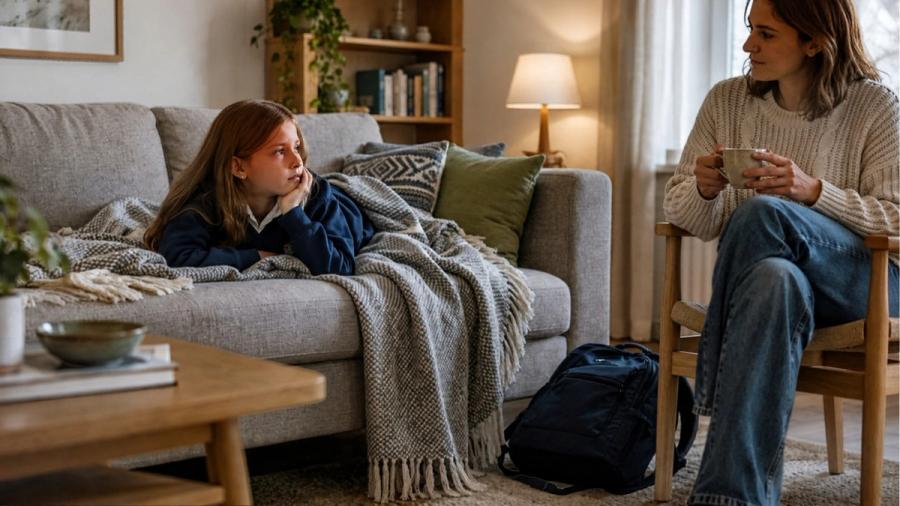
When I taught in Danish public schools, the kids who worried me least in October were not always the ones still there in February. They sat still. They copied from the board. They said fine when asked.
Parents describe the other half. The same kid sleeps for two hours after school, cries over a pencil case, or cannot face the homework that took the class ten minutes. People call this masking: holding attention, mood and movement in check for six hours because the room demands it. It is a description, not a diagnosis.
The gap matters. A class teacher who sees a calm kid can hear a parent's worry as overprotection. A parent who sees the collapse can hear the school's "she is doing well" as not being listened to. Both are telling the truth about what they see.
A kid who reads well above grade level but cannot start a written task alone. A kid who is funny and liked at break and silent in every group task. A kid who never gets a note sent home and has a stomach ache every Sunday evening.
Why ADHD school refusal is recognised late
We talk about it as if it is a motivation problem, a parenting problem or a phone problem. Often it is something plainer: a long day of effort nobody can see, in a building full of noise, transitions and waiting.
The UK charity Kids puts it simply in its guide on ADHD and school avoidance: children with ADHD "want to attend school" (Kids, updated September 2025). The guide names anxiety, sensory overload, trouble with peers and fear of failure as common drivers. Not "will not". Cannot, at least not on the terms the day is offering.
Timing matters too. A Finnish study of about 580,000 people born between 1990 and 1999, published in JAMA Psychiatry in 2026, found that those first diagnosed with ADHD from age 13 onwards did markedly worse in school than those diagnosed in childhood. At 20, about 30 percent of late-diagnosed boys and 27 percent of late-diagnosed girls were out of education or had dropped out, against roughly 9 and 10 percent of the early-diagnosed (Videnskab.dk, May 2026).
The study shows an association, not a cause. The researchers point out that quieter, inattentive ADHD tends to be noticed later than hyperactive ADHD, which may explain part of the gap. But it fits what many parents describe: a kid who coped until the demands outgrew the coping.
What the Nordic numbers say, and what they do not
The Norwegian survey by Fafo researchers Anne Kielland and Jing Liu reached 274 young people aged 13 to 17, and their parents, through patient organisations. Nearly half, 128, had periods when they often dreaded going to school. Of the 149 with high involuntary absence, about one in five left school entirely. The researchers say the sample may not represent the whole group. I think that caveat is worth keeping.
Danish data are older but point the same way. A March 2022 report from the National Institute of Public Health at the University of Southern Denmark pooled national school surveys from 2014 to 2018, covering 89,318 young people, 1,716 of whom reported ADHD or ADD (SDU, March 2022). In general upper secondary school, 33 percent of girls with ADHD or ADD reported truancy in the past month, against 14 percent of girls without. In grades 5 to 10, 72 percent of girls with ADHD or ADD said they liked school, against 85 percent of other girls.
Self-reported diagnoses in a survey are weak evidence. A weak number still beats a vague sentence, and this one says the gap shows up in wellbeing before it shows up in the absence register.
A kid who holds it together all day may be paying for it at home, where the school cannot see the bill.
Short, interesting tasks lower the daily load
What helps a masking kid is rarely a harder push. It is less hidden effort per hour: short blocks, a clear start, a visible end, and content that pulls attention instead of draining it.
When I taught, the same objective wrapped in something a kid cared about, football, horses, a game, often got started in two minutes instead of twenty. The objective did not change. The cost of starting did.
The evidence for interest is good on engagement and attention and thinner on long-term attainment. Interest is a way in, not a replacement for teaching. Three things a class teacher can try this week:
- Ask the parent what the hour after school looks like, not only how the morning went.
- Cut task length before you cut content: two 10-minute blocks with a break are easier to start than one 30-minute block.
- Build one task a week around something the kid already cares about.
What a school can do
- Ask about the evening. In the next parent conversation, ask three questions: how long does it take to come down after school, what happens at homework time, and what are Sunday evenings like. About 10 minutes.
- Map the hidden effort. With the kid, list the three parts of the day that cost the most, such as transitions, group work, noise or waiting. About 15 minutes, once.
- Shorten the first task of each lesson. A 5-minute starter the kid can finish lowers the cost of starting everything after it. About 5 minutes of planning per lesson at first, less once it is a habit.
- Offer a known adult and a known place. One named adult the kid can go to, and one quiet spot that can be used without asking twice. Agree it once with the team.
- Do not wait for an absence threshold. If tired afternoons, Sunday dread and single sick days hold for two to three weeks, bring in the municipal educational psychology service, or your country's equivalent, and invite the parents to the same meeting.
Where GradeAid fits
GradeAid is a Danish platform for teachers. The teacher types in the topic and the level and gets a lesson plan, a worksheet, a quiz, a presentation and screen-free activities in seconds, which you can also differentiate. The material can be printed. It can make the short, interest-led version of this week's task, but it does not notice masking and it does not replace the conversation between a class teacher and a parent.
If you work with kids who cope at school and collapse at home, we would like to hear from you. Write to us at founders@gradeaid.ai.
Frequently asked questions
What is ADHD school refusal?
ADHD school refusal, often called school avoidance, is when a child with ADHD finds school so emotionally or physically draining that attending becomes very hard or impossible. It is usually not defiance. Common drivers are anxiety, sensory overload, trouble with peers, fear of failure and the effort of holding attention all day. Many organisations prefer the term school avoidance because it points at the cause rather than the behaviour.
Why does my child with ADHD seem fine at school but fall apart at home?
Many kids hold attention, mood and movement in check for a whole school day because the classroom demands it. People call this masking. The effort is invisible at school and the cost shows up later, at home: exhaustion, meltdowns, refusing homework or dread on Sunday evenings. It is a description of a pattern, not a diagnosis, and it is worth telling the class teacher about.
Is school refusal more common in children with ADHD?
The evidence points that way, though much of it is survey based. In a 2026 Fafo survey of 274 neurodivergent Norwegian teenagers, 70 percent with ADHD, more than half had periods of high involuntary absence. Danish national survey data from 2014 to 2018 also show lower school wellbeing and more truancy among young people who report ADHD or ADD than among their peers.
Why is ADHD often recognised late?
Quieter, inattentive ADHD is less visible in a classroom than hyperactive ADHD, so it tends to be noticed later. Kids who mask may also look fine to teachers. A Finnish study of about 580,000 people published in 2026 found that diagnosis from age 13 onwards was linked to much weaker school outcomes than diagnosis in childhood, though it shows an association, not a cause.
How can a teacher help a child with ADHD who avoids school?
Start by asking parents what the hours after school look like. Map the parts of the day that cost the most effort with the child. Shorten the first task in each lesson, offer one known adult and one quiet place, and build some tasks around the child's interests. If the pattern lasts two to three weeks, bring in the educational psychology service early rather than waiting for an absence threshold.