Homeschooling a child with ADHD in the UK: an honest guide
AuthorFrederik Bjørnbak, Founder & CEO, GradeAid: former teacher in Denmark's public schools
10-second summary
126,000 kids were home educated in England in autumn 2025 (DfE, January 2026), and kids with SEN support are over-represented. This guide sets out the parent's legal duty, what local authorities ask for, and what the Children's Wellbeing and Schools Act 2026 will change from 2027. It gives a realistic two to three hour day for a kid with ADHD, built on NICE and EEF guidance, and says plainly when home education is not the right call.
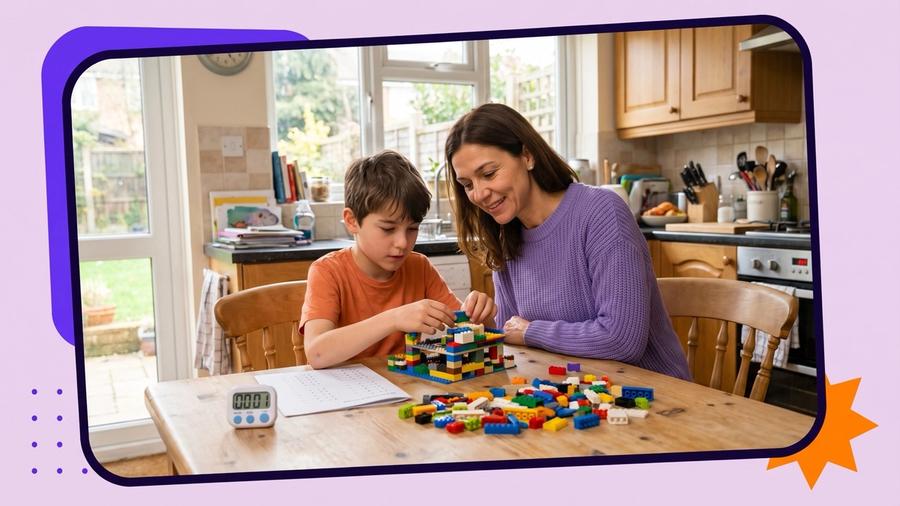
A kitchen table in England at 16:30 on a Tuesday. The school has phoned again about the reduced timetable, the medication is not doing what the SENCO hoped, and the word exclusion has come up. The parent opens Mumsnet and types the question that appears there every week: should I take my nine-year-old with ADHD out of school? Homeschooling an ADHD child in the UK is legal, more common than most people think, and sometimes the right call. It is also a full-time job. This guide covers what the law expects, what a realistic day looks like, what the 2026 Act changes, and when it is better to stay and push for support.
More kids with additional needs are now taught at home
The Department for Education's latest elective home education figures (published 15 January 2026) counted 126,000 kids in home education in England on census day in autumn 2025. The autumn before it was 111,700. That is roughly 1.5 per cent of kids of comparable age.
Of those kids, 16 per cent were recorded as getting SEN support and 7 per cent had an education, health and care plan (EHCP). For the school population as a whole the figures are 14 and 5 per cent. The DfE itself says SEN status is only what the local authority knew on census day, so the real share is probably higher. ADHD is not counted separately. Where a reason was given, the most common were mental health (16 per cent) and philosophical or preferential reasons (12 per cent).
Behind those percentages are kids I recognise from my own classroom. A kid who reads two years ahead but cannot sit through a 45-minute lesson. A kid who is fine until the class moves to the hall and the noise starts. A kid who has been on a reduced timetable so long that school now means two hours on a Wednesday. School tends to file them under behaviour. It is not behaviour. It is a setting that does not fit.
Homeschooling an ADHD child in the UK: what the law expects
In England the duty sits with the parent, not the school. Section 7 of the Education Act 1996 says every parent must make sure their child gets an efficient, full-time education suitable to their age, ability and aptitude, and to any special educational needs. The DfE's guidance for parents (April 2019, still the current version) spells out what that means in practice.
It does not mean copying school. You do not have to follow the curriculum that schools use, keep a timetable, teach school hours or hold a teaching qualification. The local authority can make informal enquiries and, if it is not satisfied, can serve a school attendance order. Most authorities ask for a short written description or one visit a year. Suitability is judged on the individual child, and for a kid with ADHD that is the point.
Two situations need more than a letter to the school. If your child is on the roll of a special school, you need the local authority's consent before taking them off it. If your child has an EHCP, the plan stays in place and must still be reviewed every year, but ask in writing what provision, if any, the authority will keep funding.
One more caution. If the school suggested home education as the way out of a reduced timetable or a threatened exclusion, stop. A school cannot require a parent to home educate. I think a decision made under that kind of pressure deserves a second opinion from someone who does not work at the school.
What changes under the Children's Wellbeing and Schools Act 2026
The Children's Wellbeing and Schools Act 2026 received Royal Assent on 29 April 2026. It brings in a Children Not in School register in every local authority in England, a duty on parents to give information for that register, and a requirement for local authority consent before withdrawing a child who attends a special school or who is subject to child protection enquiries under section 47 of the Children Act 1989.
None of it is in force yet. The government's Education Hub explainer (12 May 2026) confirms that regulations and statutory guidance come first, and commencement is expected in 2027. So the practical advice is dull: keep a short record of what your child is learning now, and registration is a formality when it arrives.
A realistic day for a kid with ADHD is two to three hours, not six
The NICE clinical guideline on ADHD, NG87 (updated 13 September 2019), recommends changes to the environment: shorter stretches of focus with movement breaks, fewer distractions, and written instructions next to spoken ones. It was written for classrooms. It works just as well at a kitchen table.
The commonest mistake is to rebuild school at home, with a six-hour day and a subject every hour. For a kid with ADHD that collapses within a fortnight.
A day many families settle into looks like this. Movement first. Then a 20-minute maths block, a break, and a 20-minute reading or writing block, both in the morning when attention is best and any medication is working. Lunch, time outside, and one afternoon block of 30 to 45 minutes on a project the kid has chosen. Finish by mid-afternoon. That is two to three hours of focused work, and for a nine-year-old with ADHD it is a full day.
Interest-led does not mean unstructured
Two things make short blocks hold. The first is the kid's own interest. A maths block built around Minecraft, football data or dinosaurs holds attention without a fight over willpower. The second is explicit teaching. The Education Endowment Foundation's guidance on special educational needs in mainstream schools (19 May 2025) names explicit instruction and scaffolding as the approaches with the strongest evidence for pupils with additional needs. Show the kid how, do one together, then let them do one alone.
A good home education day for a kid with ADHD is short, predictable and built around something the kid already cares about.
- Blocks of 15 to 25 minutes, then movement. Set a visible timer and stop when it goes, even mid-task.
- Core skills in the morning, projects in the afternoon. Reading and maths every day, briefly, and everything else through the kid's interest.
- Written instructions next to spoken ones. A card on the table saying what the block is, what done looks like, and what comes next.
When home education is not the right call
Home education is a full-time job for one adult, usually a parent who gives up income to do it. Many parents on the same forums say plainly that they cannot stop earning. The parent also becomes the teacher, and that strains some relationships already worn thin by years of trouble with school.
Some signs point to staying. If your child wants to be in school and the barrier is missing support, the better route is an EHCP needs assessment, which any parent can request from the local authority in writing. If the kid needs therapy or specialist teaching that only a plan can fund, leaving school can cut them off from it.
There are middle paths. A reduced timetable with a written reintegration plan can be a bridge rather than a dead end. Flexi-schooling, where a child attends part of the week by agreement with the headteacher, suits some families. Sometimes the answer is a different school.
What a parent can do
1. Write down what the problem actually is. Is it the setting (noise, size, pace), the support, or one particular teacher? Each points to a different answer. About 30 minutes, once.
2. Ask for the adjustments first. Email the SENCO the NICE modifications: shorter tasks, movement breaks, written instructions, a quiet space. If nothing changes, request an EHCP needs assessment in writing. One email of about 20 minutes, then a letter of about an hour.
3. If you decide to go ahead, do it properly. Write to the headteacher asking for your child to be taken off the roll from a stated date, check whether special school consent applies, and tell the local authority. About an hour, once.
4. Run a two-week trial rhythm and keep a light record. Short blocks, morning core skills, afternoon project. One photo a day and a one-page description of your approach is what most local authorities want to see. Five minutes a day.
5. Protect the social side. Home education groups, sport, clubs, a regular meet-up with a friend from the old class. Isolation is the regret parents mention most. Two fixed slots a week in the diary.
6. Review after a term. Is your child calmer, learning, and seeing other kids? If two of the three are missing, revisit the decision. Going back to school is allowed. One evening, once a term.
Where GradeAid fits
GradeAid is a Danish platform for teachers. The teacher types in the topic and the level and gets a lesson plan, a worksheet, a quiz, a presentation and screen-free activities in seconds, which you can also differentiate. The material can be printed. Homeschooling parents use it the same way. It does not replace a parent, a diagnosis or a plan, and it is not a reason to leave school.
If you work with children with ADHD who are learning at home, we would like to hear from you. Write to us at founders@gradeaid.ai.
Frequently asked questions
Is it legal to homeschool a child with ADHD in the UK?
Yes. In England, Wales, Scotland and Northern Ireland parents may educate at home, and a diagnosis makes no difference to that right. In England the parent must provide an efficient, full-time education suitable to the child's age, ability, aptitude and any special educational needs (Education Act 1996, section 7). If the child attends a special school, the local authority must consent before the child comes off the roll.
Do I have to follow the national curriculum when home educating?
No. The Department for Education's guidance for parents (April 2019) says home-educating families do not have to follow the curriculum that schools use, keep a set timetable or teach school hours. The local authority can make informal enquiries and can act if it thinks the education is unsuitable, so keep a short written description of your approach and a few examples of work.
What happens to my child's EHCP if I home educate?
The plan does not disappear. The local authority must still review it every year and consider whether the education you provide is suitable. Whether it keeps funding the provision in the plan depends on the circumstances, so ask in writing before you deregister. If the plan names a special school, you need the authority's consent to withdraw your child.
How many hours a day should a child with ADHD do at home?
There is no legal minimum. Two to three hours of focused work, split into blocks of 15 to 25 minutes with movement breaks between them, is a realistic full day for a primary-aged kid with ADHD. NICE guidance NG87 (2019) recommends shorter periods of focus with movement breaks, which suits home education well. Consistency matters more than the length of the day.
Will the 2026 Act stop me from home educating?
No. The Children's Wellbeing and Schools Act 2026 (Royal Assent 29 April 2026) brings in local authority registers of children not in school and a duty on parents to give information, plus a consent requirement for kids at special schools or under child protection enquiries. Those provisions are not yet in force and need regulations first, with commencement expected in 2027. Home education stays lawful.