My child hates school: what to do, step by step
AuthorFrederik Bjørnbak, Founder & CEO, GradeAid: former teacher in Denmark's public schools
10-second summary
A triage guide for parents whose kid has started to hate school a few weeks into the autumn term. It separates five common causes, boredom, anxiety, a learning gap, a social problem and a neurodivergent mismatch, with the signs and first steps for each, drawing on Børns Vilkår, VIVE and the Danish Ministry of Children and Education, Autismeforeningen, sundhed.dk, the Norwegian Directorate for Education (Udir), Skolverket and FHI, with YoungMinds and the DfE as the UK voices. It explains the route to help in Denmark (the municipal educational psychology service), Norway (the educational psychology service), Sweden (the school health team) and England (SENCO), and why learning through a kid's interest is a bridge back to school rather than a cure. It ends with five numbered steps a parent can take this week.
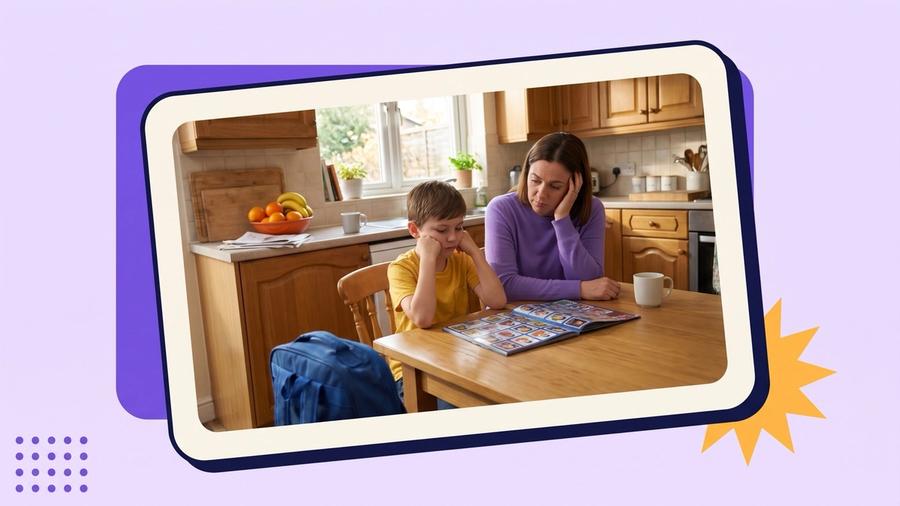
12,030 kids in Denmark's public schools missed more than 50 school days in 2024/25 (Børns Vilkår via DR, 7 May 2026). Most of them started with a smaller sentence, said at the kitchen table three weeks into the autumn term: I hate school. If you are searching for my child hates school, what to do, the answer depends on why. Boredom, anxiety, a learning gap, a social problem and a neurodivergent mismatch all produce the same sentence, and each needs a different first step. This is a triage for parents in Denmark, the Nordics and Europe.
Why the reason matters more than the sentence
Børns Vilkår's analysis of Statistics Denmark data, reported by DR (7 May 2026), puts those 12,030 kids at 2.4 per cent of all public-school pupils. They missed 80 of 200 school days on average, and for 61 per cent of them nobody had sent a safeguarding notification to the municipality.
The share of public-school pupils with long-term concerning absence, at least 20 per cent absence in two quarters in a row, rose from 3.2 per cent in 2018/19 to 5.1 per cent in 2024/25 (Danish Ministry of Children and Education and VIVE, 27 August 2026). VIVE's first recommendation is to act at the first signs.
A kid who reads two years ahead and kicks the table by ten o'clock. A kid who is sick every Sunday night and fine every Saturday. A kid who is quiet at school and in pieces at home by 16:30. We talk about it as if it is a discipline problem, a parenting problem, a phone problem. It is a matching problem: something in the school day does not fit the kid.
Hating school is a symptom; find the cause before you choose the cure.
My child hates school: what to do depends on which of five reasons is driving it
1. Boredom: too easy, or hard and called boring
Signs: the work is too easy, the kid finishes early and gets into trouble, and is cheerful at weekends. The complaint is about lessons, not people.
First steps: ask the class teacher what your kid does after finishing a task, and ask for a stretch task rather than more of the same. When I taught in the Danish public school system, the kids who called maths boring were rarely the ones who finished first.
2. Anxiety: not will not, cannot
Signs: the Danish patient handbook on anxiety in children (sundhed.dk, updated 30 January 2024) lists stomach aches and nausea before the feared situation, refusing school in the morning and trouble sleeping. The UK charity YoungMinds' guide on school anxiety and refusal (reviewed December 2025) adds the pattern parents recognise: fine on Saturday, worse on Sunday evening, panic at the door.
A kid frozen at the door at 7.55 is not refusing. Not will not. Cannot. First steps: find the specific worry, a teacher, a test, a corridor. Keep the kid going with adjustments. YoungMinds says: "Try not to shout, tell them off or physically force them into school". I think the school gate at 8.00 is the wrong place to win this argument.
3. A learning gap: one subject, one topic, one bad fortnight
Signs: the hatred is specific to one subject, homework battles cluster around reading or maths, and the change came after a new topic. Stupid and pointless both mean I cannot do it.
First steps: ask the class teacher for evidence, not reassurance: where is your kid against the goals for grade 4, and what is the missing piece? A gap that is not closed turns into avoidance.
4. A social problem: the dread has a time, not a subject
Signs: the dread attaches to times rather than lessons: break, lunch, PE, the bus, the group chat. In the Danish national well-being survey, 5.0 per cent of public-school pupils said in 2025/26 that they were bullied often or very often, up from 3.1 per cent five years earlier (the national pupil wellbeing survey, reported by TV 2, May 2026).
First steps: ask about times of day, not about school, and write down what you hear with dates. Ask the school for a named contact and its anti-bullying strategy (antimobbestrategi).
5. A neurodivergent mismatch: fine at school, in pieces at home
Signs: the kid holds it together at school and falls apart at home, complains about noise and lights, and finds transitions hardest. Autismeforeningen's survey of 1,405 Danish parents (5 November 2025) found that 46.7 per cent of autistic kids had experienced involuntary school absence, and 22.8 per cent had been out for more than 12 months. The parents point to staff without autism knowledge and constant changes. Not to the kids.
First steps: do a sensory audit with your kid, hour by hour. Ask for adjustments now rather than after a diagnosis: a visual timetable, a quiet space, a known adult at the gate on Monday morning.
Who to ask, country by country
In Denmark the route to help is the municipal educational psychology service. Parents can contact the psychology service directly, and its assessment opens the door to special education (Skole og Forældre, updated 3 April 2025). In Norway it is the educational psychology service, and the Norwegian Directorate for Education (Udir) (updated 22 October 2025) asks schools to call a physical meeting early and agree who does what. In Sweden the school leader must open an investigation when absence is repeated or prolonged, with the pupil, the guardian and the school health team (Skolverket, updated 17 August 2026). In England the first stop is the SENCO (DfE attendance guidance, July 2026).
The Norwegian Institute of Public Health reviewed 38 studies on school-home cooperation around absence (FHI, 1 June 2026) and found four things that work: two-way dialogue, a relationship built before the crisis, clear roles and a fixed time to meet. So bring facts, ask for a plan, and ask who owns it.
Learning through the thing your kid loves is a bridge, not a cure
A kid who hates school soon reaches a second conclusion: I am bad at learning. That belief is the part a parent can work on at home. At 16:30, before dinner, put the subject that hurts inside the thing your kid already loves: fractions through football statistics, a paragraph about a Minecraft build. Ten minutes, no marking, the kid chooses the theme. It is a bridge back to school, not a cure.
What a parent can do this week
1. Keep a two-week log. Note each day the kid resisted, the time of day, and any physical symptom. Ask one narrow question in the car: what is the worst twenty minutes of the day. Cost: two minutes a day.
2. Book the class teacher within the week. Ask three things: what does my kid do when a task is finished, where are they in reading and maths, and who do they sit with at lunch. Agree a review date three weeks out. Cost: about 30 minutes once.
3. Keep attendance going with adjustments, not all or nothing. Ask for a later start or a quiet first lesson. The DfE guidance warns that a prolonged absence may heighten anxious feelings about attending in future. Cost: one email, about 10 minutes.
4. See your own doctor if symptoms persist. Symptoms lasting more than a few weeks are worth a check, and a doctor's note helps the school and the psychology service take it seriously. Cost: about an hour with the wait.
5. Escalate at the review if nothing has moved. In Denmark ask the school to refer to the psychology service, or contact it yourself. In Norway ask for the educational psychology service, in Sweden ask the school leader whether the absence investigation has started, in England ask the SENCO. Cost: about an hour, then the waiting.
Where GradeAid fits
GradeAid is a Danish platform for teachers. The teacher types in the topic and the level and gets a lesson plan, a worksheet, a quiz, a presentation and screen-free activities in seconds, which you can also differentiate. The material can be printed. Homeschooling parents use it the same way. It does not diagnose anything, and it only helps once an adult has planned the week and put the class's learning goals inside the theme the kid cares about.
If you work with kids who are struggling to be in school, as a parent, a special school or a municipality, we would like to hear from you. Write to us at founders@gradeaid.ai.
Frequently asked questions
Is it normal for a child to hate school?
Yes, most kids say it at some point, and a few weeks of grumbling after the summer is common. It becomes worth acting on when it lasts more than two or three weeks, comes with stomach aches or headaches, disturbs sleep, or attaches to one subject, one time of day or one person. VIVE's advice to Danish schools (August 2026) is to act at the first signs, and the same goes for parents.
What are the signs that my child's school refusal is anxiety?
The Danish patient handbook (sundhed.dk) lists stomach aches, headaches, palpitations and nausea before the feared situation, refusing school in the morning, avoiding birthday parties and trouble sleeping. The pattern parents recognise is a kid who is fine on Saturday, worse on Sunday evening and panicking at the door. If it is strong and lasts for weeks, see your own doctor and tell the school the same day.
Should I force my child to go to school if they hate it?
Not by shouting or physical force, which YoungMinds warns tends to make anxiety worse. But keeping attendance going with adjustments is usually better than stopping altogether: VIVE's first recommendation to Danish schools is earlier action, and the DfE notes that a prolonged absence can make the return harder. Ask the school for a later start, a quiet first lesson or a known adult at the gate while the cause is worked out.
Who do I contact in Denmark if my child refuses to go to school?
Start with the class teacher and ask for a meeting within the week. If the problem does not move, ask the school to involve the municipal educational psychology service, or contact it directly yourself. If there are physical symptoms, see your own doctor. In Norway the equivalent is the educational psychology service, in Sweden the school health team, and in England the school's SENCO.
What should I ask the school when my child hates school?
Bring a two-week log and ask three concrete questions: what does my kid do when a task is finished, where are they in reading and maths, and who do they sit with at lunch. Then ask for a named contact and a written plan with a review date in about three weeks. The Norwegian FHI review (June 2026) found that clear roles and a fixed time to meet are what make school-home cooperation work.