Norway limited AI in primary school. What it means for teachers
AuthorFrederik Bjørnbak, Founder & CEO, GradeAid: former teacher in Denmark's public schools
10-second summary
Norway's government announced on 19 June 2026 that pupils in grades 1 to 7 should in all main respects not use generative AI, with cautious use in grades 8 to 10 and detailed guidance from the Norwegian Directorate for Education (Udir) due by 1 October. The reasoning is precautionary and rests on falling results, confirmed by PISA 2025 on 8 September. Denmark, Sweden and England have no age line but all treat teacher-facing use as the low-risk case. The post sets out six steps a primary school can take now.
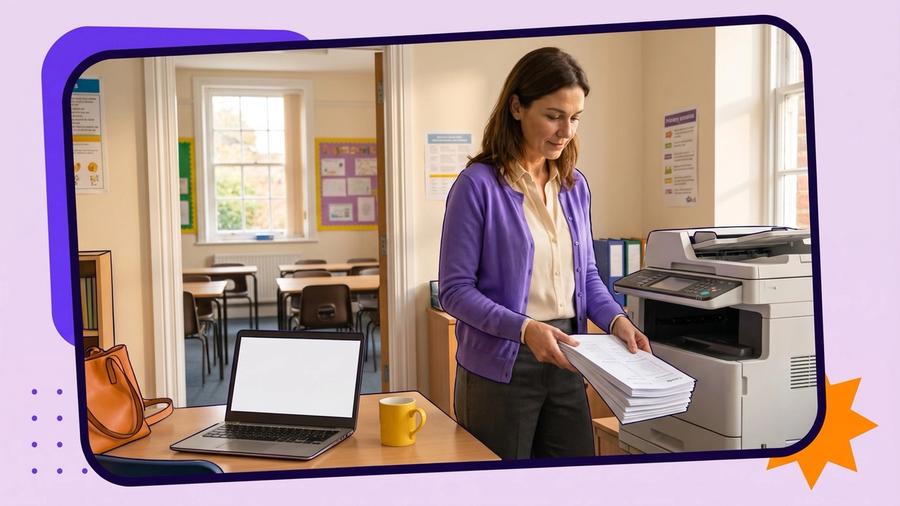
34 per cent of Norwegian 15-year-olds read below the OECD's baseline level in PISA 2025 (the Norwegian Directorate for Education, Udir, 8 September 2026). Three months earlier, on 19 June 2026, the government had already decided that kids in grades 1 to 7 should in all main respects not be given access to generative AI. It is the clearest line any Nordic country has drawn on AI in primary schools, and Denmark, Sweden and England face the same question: what should a nine-year-old be doing with a chatbot? For the teacher at the staffroom printer on Monday morning, the useful detail is what it does not cover.
Norway restricted the kid's screen, not the teacher's laptop
The recommendation has three tiers. Udir's summary from 25 June 2026 puts it plainly. In grades 1 to 7, pupils should in all main respects not be given access to generative AI. In grades 8 to 10, generative AI can be used gradually and cautiously, on the condition that teachers have first acquired sufficient competence before pupils get instruction and access. Upper secondary pupils should learn to use it appropriately for academic work and what comes after.
This is a national recommendation, not a law. Schools are expected to follow it, but Udir said it would elaborate the advice by 1 October, including exceptions and uses where AI is an underlying technology in learning materials or tools. So the detailed rules were not ready when schools opened in August.
And the restriction is about the kids' own use of generative AI. Not the teacher's laptop. The kid's screen. Nothing stops a teacher using AI to prepare a lesson, differentiate a worksheet or draft a letter to parents.
The reasoning: kids should read and write before they prompt
Prime Minister Jonas Gahr Støre gave the rationale to NRK on 19 June 2026. Uncritical use of AI in school, he said, "increases the risk of skipping important steps in learning", and he tied the decision to falling results in Norwegian schools. The government's message: kids should learn to read, write and count before they use AI.
The results he referred to arrived in full on 8 September 2026. Udir's PISA 2025 report, based on about 6,500 Norwegian 15-year-olds in 281 schools, shows reading down 24 points and mathematics down 17 points since 2022. Norway now sits below the OECD average in reading, mathematics and science for the first time since 2006, and 38 per cent of pupils performed below level 2 in mathematics.
The evidence is thinner than the headline. PISA tests 15-year-olds, so it cannot measure what a chatbot does to a seven-year-old's reading, and the decline began well before ChatGPT. We talk about AI in school as a cheating problem, a phone problem, a screen-time problem. It is a practice problem: whether a nine-year-old ever does the hard part herself. I think Norway is right about grades 1 to 7, and I think the October guidance will matter more than the June headline.
AI in primary schools: Denmark, Sweden and England have no age line
Denmark: seven recommendations, no age line
Denmark's Ministry of Children and Education and its agency, the Danish Agency for Education and Quality (STUK), published seven recommendations for the Danish public school system on 26 June 2025. They ask each school to set a shared direction for AI use, use only GDPR-compliant tools, prioritise staff competence, use AI only where it makes pedagogical sense, talk with pupils about how and why, and tell parents. No age threshold; the school and the municipality decide. The minister, Mattias Tesfaye, put it this way: "It must never become a cheating tool, but it may well be a learning tool."
Sweden: four in ten teachers already let kids use AI
Skolverket's follow-up of 26 May 2026 surveyed 368 teachers in its web panel (compulsory school, preschool class and after-school care) in autumn 2025 and early spring 2026. Nearly eight in ten had used AI in their work, seven in ten for planning. Four in ten had initiated or approved pupil use in lessons, up from just under two in ten in 2024, though most said pupils used it to a small extent. The panel is not nationally representative, and Skolverket has set no age restriction.
England: teacher-facing use first, pupil-facing with conditions
The Department for Education's guidance on generative AI in education, last updated 12 August 2025, says the department sees "more immediate benefits and fewer risks from teacher-facing use". Pupil-facing tools require great care on data protection and safeguarding, compliance with each tool's own age limit, close supervision, filtering and monitoring. England has no national age line, but most open chatbots set their minimum age at 13 or 18, so primary pupils are outside them already.
The line runs between the teacher's desk and the kid's screen
All four countries accept teachers using AI to produce materials; Skolverket's panel (May 2026) shows planning is the most common use; the DfE (August 2025) built its guidance on it. What differs is the pupil-facing chatbot: Norway says no in grades 1 to 7, England says yes with heavy conditions, Denmark and Sweden leave it to local judgement.
Three kids show what the line is for. A kid in fourth grade who lets the chatbot write the story and never finds out how her own sentence starts. A kid with dyslexia whose reading support has AI underneath and could lose it to a headline. A kid in eighth grade whose teacher has never opened the tool she must supervise.
- A teacher generating a differentiated text or a set of word problems with AI is on the permitted side in all four countries.
- A kid in grades 1 to 7 typing into a chatbot is the case Norway has closed.
- Tools where AI runs underneath, such as adaptive practice or reading support, are the grey zone, and Norway has promised to clarify them by 1 October.
Norway has not banned AI from primary schools; it has banned the chatbot from the kid's hands while leaving the teacher's tools alone.
What a school can do
1. Sort every AI use into two columns, teacher-side and pupil-side, on one sheet of paper. About 30 minutes once, in a staff meeting. In a Norwegian primary school the pupil-side column stays empty until Udir's October guidance says otherwise.
2. Check the age terms of every tool a pupil can reach from a school device. About 10 minutes per tool, done by the ICT coordinator. If a service sets its minimum age at 13, it has no place on a ten-year-old's device, whatever national policy says.
3. List the tools where AI is an underlying technology, such as adaptive maths practice, speech-to-text or reading support for pupils with dyslexia, and decide on each one separately. About an hour once, with the special needs coordinator in the room. Do not let a headline ban switch off the support a kid with special needs depends on.
4. Give handwriting, reading aloud, mental arithmetic and oral explanation a fixed slot in the timetable. No extra time, just a decision at the next year-group meeting. When I taught in the Danish public school system, ten minutes of reading aloud at the start of the day did more for the weakest readers than any device.
5. Tell parents in plain language which tools are used and which are not, as the Danish recommendations (June 2025) ask. One paragraph in the next newsletter, about 15 minutes to write.
6. Book teacher training before any pupil access. Norway makes teacher competence a condition for pupil use in grades 8 to 10 (Udir, 25 June 2026). One 45-minute staff meeting this term on what generative AI is and is not.
Where GradeAid fits
GradeAid is a Danish platform for teachers. The teacher types in the topic and the level and gets a lesson plan, a worksheet, a quiz, a presentation and screen-free activities in seconds, which you can also differentiate. The material can be printed. The kid never sits in front of a chatbot, so GradeAid sits on the teacher side of Norway's line, though the worksheet is still our weakest output: 47.6 percent of worksheets were edited after generation (our own data, 14 September 2026), a high number we would rather say than hide.
If you work with AI policy in a primary school, a municipality or a local authority, we would like to hear from you. Write to us at founders@gradeaid.ai.
Frequently asked questions
Has Norway banned AI in primary schools?
Not by law. On 19 June 2026 the Norwegian government announced a national recommendation, and the Norwegian Directorate for Education (Udir) confirmed it on 25 June: pupils in grades 1 to 7 should in all main respects not be given access to generative AI. Schools are expected to follow it, and Udir will publish detailed guidance with exceptions by 1 October 2026. Teachers may still use AI to prepare lessons.
Can teachers in Norway still use AI to plan lessons?
Yes. The Norwegian recommendation restricts pupils' own access to generative AI in grades 1 to 7. It does not restrict teachers using AI to prepare materials, differentiate tasks or draft communication. In grades 8 to 10, Udir makes teacher competence a condition before pupils are given instruction and access, which underlines that the teacher's use comes first.
What does Denmark recommend on AI in the Danish public school system?
In June 2025 the Danish Ministry of Children and Education and the Danish Agency for Education and Quality (STUK) published seven recommendations. Schools should set a shared direction for AI use, use only GDPR-compliant tools, prioritise staff competence, use AI only where it makes pedagogical sense, talk with pupils about when and why they may use it, and inform parents. There is no national age limit; each school and municipality decides.
What is the DfE guidance on AI for primary schools in England?
The Department for Education's guidance, last updated in August 2025, sees more immediate benefits and fewer risks from teacher-facing use. Pupil-facing tools require great care on data protection, safeguarding and intellectual property, close supervision, filtering and monitoring, and compliance with each tool's own age limit. Since most open chatbots require users to be 13 or 18, primary pupils are usually excluded in practice.
Why did Norway decide to limit AI for younger pupils?
The government argued that uncritical AI use increases the risk of pupils skipping important steps in learning, and that reading, writing and arithmetic must come first. PISA 2025, published on 8 September 2026, showed Norwegian 15-year-olds down 24 points in reading and 17 in mathematics since 2022 and below the OECD average in all three subjects. The recommendation is explicitly precautionary.