Homeschooling in Europe 2026: laws and numbers by country
Frederik Bjørnbak, Founder & CEO, GradeAid: former teacher in Denmark's public schools
10-second summary
Homeschooling in Europe is legal and supervised in Denmark and Norway, registered in Ireland, unregistered for now in England, subject to authorisation in France and not allowed in Germany. The counts are rising almost everywhere: 2,560 kids in Denmark in 2025/26, 452 in Norway, more than 2,500 in Ireland and 126,000 in England. France fell after it moved to prior authorisation in 2021. The figures are counted differently, so read them as direction, not a league table.
126,000. That is how many kids were home educated in England on census day in autumn 2025 (DfE, January 2026). It is the biggest number in any conversation about homeschooling in Europe, and the least useful one if you live in Aarhus, Bergen or Lyon, because the rules there are completely different.
Parents ask me this every few weeks, usually after a hard term: can we just teach our kid at home? The honest answer is that it depends on which border you live inside. This guide puts the law and the latest count side by side for six countries, Denmark and Norway first, with every number linked to where it came from.
Homeschooling in Europe: one right, six very different rules
Most European countries make education compulsory. Fewer make school compulsory. That one word decides almost everything for a family.
Denmark asks for education. Germany asks for a school.
Between those two sit the rest: countries that let parents teach at home but check the result, a country that keeps a register, a country that has no register yet, and France, which moved from a simple declaration to prior authorisation in 2021 and is now arguing about moving back.
Country by country: the law and the latest count
Denmark: legal, and the municipality checks
The Danish constitution puts the duty on education, not on attending school. Parents may teach at home, but the teaching has to stand up to what is expected in a Danish public school, and the municipality supervises it.
Folkeskolen magazine surveyed the municipalities and counted 2,560 home-educated kids across 90 municipalities in the 2025/26 school year, against a ministry estimate of 443 ten years earlier (Folkeskolen, September 2025). That is roughly a sixfold rise.
Norway: legal, small and growing
Norway also allows home education, with the municipality responsible for checking that the kid gets an education in line with the curriculum. The numbers are small. Udir counted 452 home-educated kids in 2025/26, 0.07 percent of all kids in primary and lower secondary school, up from 0.03 percent in 2016/17 (Udir, December 2025).
Ireland: a constitutional right with a register
The Irish constitution names the family as the primary educator, and the Education Act requires home-educating families to be on a register held by Tusla, the Child and Family Agency. More than 2,500 kids were on that register at the end of June 2025, up from 1,566 in June 2020, an increase of almost 60 percent (Irish Examiner, September 2025).
England: the largest number and no register yet
In England, parents do not need permission and, for now, do not have to register. A statutory register is coming under the Children's Wellbeing and Schools Act 2026, but not before 2027.
The Department for Education counted 126,000 home-educated kids on census day in autumn 2025, up 12.8 percent from 111,700 a year earlier, and 175,900 at some point during 2024/25 (DfE, January 2026). Mental health was the most reported reason, at 16 percent of known reasons.
France: authorisation since 2021, and a push to loosen it
France required only a declaration until the 2021 law on respect for the principles of the Republic made home education subject to prior authorisation. The count fell from 72,369 kids in 2021/22 to 55,747 in 2022/23, and about 30,000 authorisations were granted for 2025/26.
On 7 October 2026, a parliamentary information mission led by Josiane Corneloup and Vincent Trébuchet proposed a return to a simple declaration for ages 3 to 5, a reinforced declaration from age 6 and more checks after the fact (LCP, October 2026). It is a proposal, not a law.
Germany: school attendance is compulsory
Germany is the clear exception. Attending school is itself the duty, and the courts keep saying so. On 13 January 2026 the administrative court in Münster dismissed a case brought by parents who taught their kids at home for religious reasons, supported by an association that called itself a home school.
The court found the association was not a school, so the duty to enrol was not met, and it did not matter whether the kids were being educated in other ways (Verwaltungsgericht Münster, January 2026). The parents can still ask for leave to appeal.
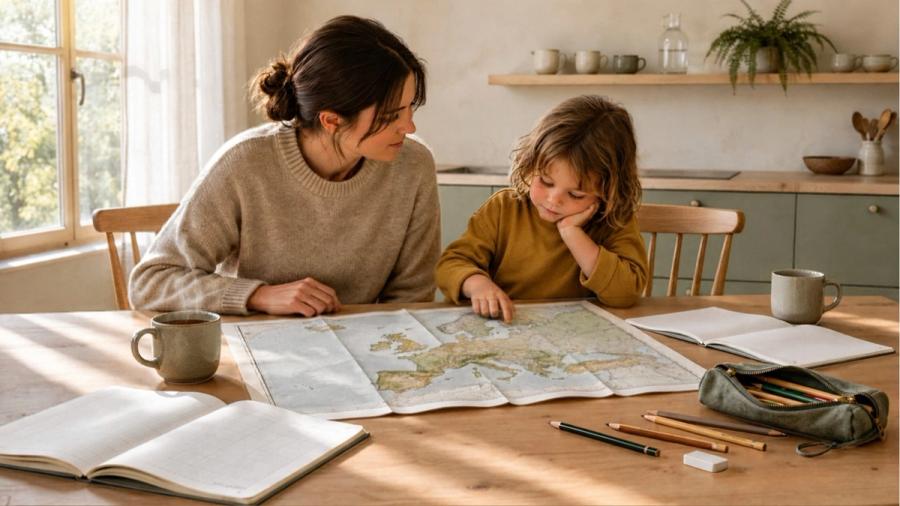
The same kid at the same kitchen table is a supervised right in Copenhagen and Oslo, a register entry in Dublin, an authorisation in Lyon and a court case in Münster.
What the numbers say, and what they do not
The counts are not comparable one to one. England counts on a census day, the Danish figure is a magazine's survey of municipalities, Ireland's is a register and France counts authorisations. Read them as direction, not as a league table.
The direction is the same almost everywhere. Up in Denmark, up in Norway, up in Ireland, up in England. France went down only after the law changed.
We talk about the rise as an ideology story, a pandemic story, a phone story. The one country that asks families why points somewhere else: in England, mental health is the most reported reason. I think that is the figure every school leader in Europe should read twice.
Behind the totals are kids like these. A kid who has not managed a full school week since grade 4. A kid who reads two years ahead but shuts down in a class of 28. A kid whose family moved countries and found the new school could not meet them.
Three things hold in every country above:
- Check whether your country requires school or education. That decides whether home education is an option at all.
- Expect someone to check the learning: the municipality in Denmark and Norway, Tusla in Ireland, the education authority in France, and a register in England from 2027 at the earliest.
- Keep evidence from week one. A short weekly record is easier than rebuilding a whole term before a supervision meeting.
What a parent can do
If you are weighing home education after a hard year, these steps take about two and a half hours in the first week, then about 15 minutes a week.
- Read your own country's rule first, from the ministry or the municipality, not from a forum. About 30 minutes.
- Talk to the school before you decide. In Denmark, a kid with long illness can have a right to home teaching during illness, which keeps the school place. Ask the class teacher and the school leader what they can offer. One meeting.
- If you go ahead, find out who supervises and what they will ask to see, and write it on one page. About 20 minutes.
- Plan the week around what the class is working on, so a return to school stays possible. About 45 minutes once, then 10 minutes a week.
- Keep a simple record: one photo or a few lines per subject per week. About 5 minutes a week.
Where GradeAid fits
GradeAid is a Danish platform for teachers. The teacher types in the topic and the level and gets a lesson plan, a worksheet, a quiz, a presentation and screen-free activities in seconds, which you can also differentiate. The material can be printed. Homeschooling parents use it the same way. It does not know your country's supervision rules, and the worksheet is still our weak spot: 47.6 percent of worksheets get edited after generation (GradeAid data, September 2026).
If you work with home-educating families anywhere in Europe, we would like to hear from you. Write to us at founders@gradeaid.ai.
Frequently asked questions
Is homeschooling legal in Europe?
It depends on the country. Denmark, Norway, Ireland, England and France allow home education, each with its own checks: municipal supervision in Denmark and Norway, a Tusla register in Ireland, prior authorisation in France and, from 2027 at the earliest, a register in England. Germany requires school attendance, and German courts have upheld that as recently as January 2026.
In which European country is homeschooling not allowed?
Germany is the best-known example. The duty there is to attend school, not just to be educated, and courts enforce it. In January 2026 the administrative court in Münster ruled against parents who taught their kids at home for religious reasons, because the association supporting them was not a school. Rules elsewhere vary, so check the education ministry of the country in question.
How many children are homeschooled in Europe?
There is no single European count, because each country counts differently. The latest national figures are 126,000 in England on census day in autumn 2025, 2,560 in Denmark in 2025/26, 452 in Norway in 2025/26 and more than 2,500 in Ireland in June 2025. France granted about 30,000 authorisations for 2025/26.
Do homeschooled kids have to follow the curriculum?
In most countries, the teaching has to be comparable to school, though the exact test differs. In Denmark it has to stand up to what is expected in a Danish public school, and the municipality checks. In Norway the municipality checks that the education is in line with the curriculum. France and Ireland also assess what families provide. Ask your supervising authority what evidence it expects.
Can I homeschool my child if they cannot cope with school?
In Denmark, Norway, Ireland and England, yes, within each country's rules. Before you decide, ask the school what it can offer. In Denmark, a kid with long illness may have a right to home teaching during illness, which keeps the school place. If you do choose home education, plan the week around what the class is working on so a return stays possible.