Work for pupils not attending school: how to send it home well
AuthorFrederik Bjørnbak, Founder & CEO, GradeAid: former teacher in Denmark's public schools
10-second summary
Danish guidance no. 9580 (19 August 2024) requires the school leader to act by day 15 of absence and allows the work to be theme-based on the pupil's interests; since January 2026 parents must be contacted at day 10. Norway (Udir, October 2025) asks schools to follow the pupil academically while absent, Sweden (Skolverket, August 2026) requires an investigation, and England (DfE, July 2026) allows remote education only inside a reintegration plan. NFER (March 2025) found materials sent home were widely used but rated effective by only 35 percent of teachers. The post gives five rules, a worked grade 5 example on fractions and horses, and a five-step plan for a school costing about one hour once and 25 minutes a week.
5.1 percent. That is the share of kids in Denmark's public schools with long-term concerning absence in 2024/2025, up from 3.2 percent in 2018/2019 (VIVE and the Ministry of Children and Education, 27 August 2026). Behind each of them is a class teacher with the same question on a Sunday evening: what work do I send home this week, and will it help or make things worse? This post is about work for pupils not attending school: what the rules in Denmark, Norway, Sweden and England ask for, five rules that hold up at a kitchen table, and one worked example for grade 5.
The Danish rule is stricter than most staffrooms think
Guidance no. 9580 of 19 August 2024 on home teaching during illness says the school leader must contact the parents no later than 15 school days of absence to assess whether the kid needs teaching at home. It applies to anxiety, depression and OCD as well as physical illness, and it names long-term concerning absence, which it notes is also called school avoidance in practice. A kid doing well academically is not a reason to skip it.
Since January 2026 the clock starts earlier. At 10 days of combined sick and unlawful absence in a quarter the school leader must contact the parents, and at 15 days the school must assess what support the kid needs and, where school attachment is the problem, write a support plan (Ministry of Children and Education, 27 August 2026).
The content rule is the part teachers miss. The teaching at home should follow the school's own teaching plans as far as possible, with the scope adapted to the kid's age and health, and there is no minimum number of hours. Then comes the line I would put on every staffroom wall. Where a kid is not motivated, for example because of psychological distress, the guidance says the work can be run as "theme-based teaching built on the pupil's interests". The ministry wrote that, not an EdTech start up.
Section 6.5 adds that for a kid with school avoidance the relationship comes first, but the teaching that secures academic progress must not be left out.
Norway and Sweden say the same thing in fewer words
The Norwegian Directorate for Education (Udir) updated its page on how a school handles concerning absence on 22 October 2025. It asks the school to contact parents early, invite them to a physical meeting, involve the educational psychology service, and follow the pupil closely "academically and socially, also when the pupil is not at school".
Sweden's Skolverket page on absence from school (updated 17 August 2026) puts the duty on the school leader: repeated or longer absence must be investigated promptly and reported to the school's governing authority. On what to send home it says nothing.
England, in one sentence: the Department for Education's statutory attendance guidance (July 2026 edition) says remote education should only be used as a last resort and as part of a reintegration plan. NFER (March 2025, 606 secondary teachers and leaders surveyed in November 2024) found lesson materials sent during absence were used with the majority of pupils, yet only 35 percent of teachers rated them effective.
The schools are not short of worksheets to send. They are short of a reason the kid would open them.
Five rules for work for pupils not attending school
We usually talk about the work as the problem: too much, too little, too late. In 2023 I was teaching in a special needs class in Denmark. The work was rarely the problem. The missing loop was. A kid in grade 3 who cries at the school gate. A kid in grade 6 with autism who can do the fractions but not the corridor. A kid in grade 8 who stopped after one bad week and has not found the way back in. The same five rules held for all three.
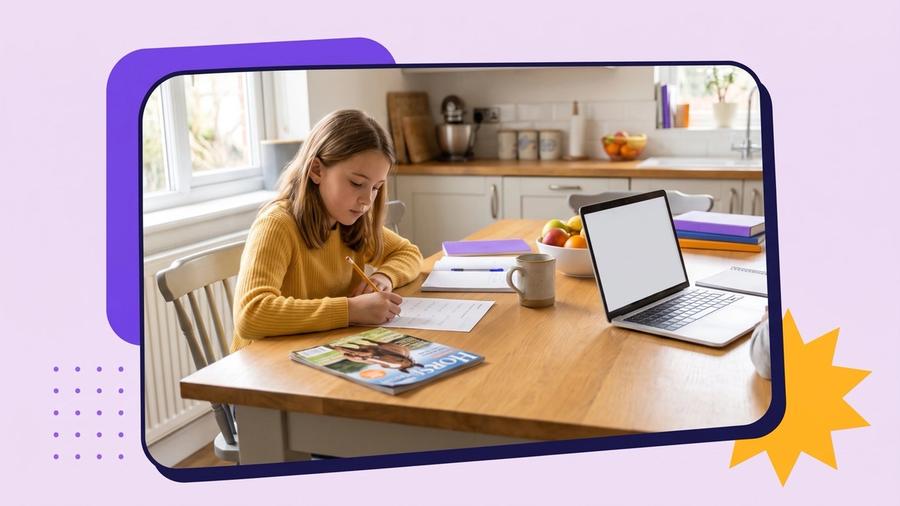
Short. One task of 15 to 20 minutes, three days a week. A kid with anxiety at a kitchen table at 10:15, a parent working in the next room, does not have 45 minutes of school in them.
Interest-led. The guidance's own line. Horses, football, Minecraft, dinosaurs. The maths does not change. The world it is set in does.
Matched to what the class is doing this week. Not a catch-up pack from September. If the class is on fractions, the kid is on fractions. When the kid comes back, the words on the board are words they have already seen.
No deadline. A deadline is the exact mechanism that keeps an anxious kid away. The work is done when it is done. The parent sends a photo, or does not.
A feedback loop of five minutes a week. One adult, the same adult, replies to the photo on Friday. One sentence about the work, one about what the class did. Guidance 9580 calls this a fixed contact person. The reply keeps the kid attached to the class, and it costs five minutes.
Work sent home helps when it is short, set in the kid's own world, and answered by a person within a week.
I think a catch-up pack is the wrong tool here. It signals distance, and it has a deadline built in.
A worked example: grade 5, horses, fractions
The class is on equivalent fractions and adding fractions with the same denominator. The kid loves horses and has been at home for four weeks. Monday's sheet, five items, 20 minutes:
- A stable has 12 boxes. 3 have ponies in them. What fraction of the boxes have ponies? Simplify it.
- The morning feed is 3/4 of a bucket of oats. The evening feed is 1/4 of a bucket. How much is that per day?
- 2/8 of the paddock is fenced off for a foal. Is that the same as 1/4? Draw the paddock and show why.
- A 40-minute ride: 1/4 walking, 1/4 trotting, the rest cantering. How many minutes of cantering?
- Write one fraction question about your own horse, or a horse you would like to have, and answer it.
Wednesday is a 10-minute screen-free task: measure a bucket of "feed" (rice, oats, anything in the cupboard) into halves and quarters with a cup and write the fractions on a sticky note. Friday the parent photographs both and the class teacher replies with two sentences. Writing the sheet by hand takes about 20 minutes.
What a school can do
- Day 10 of absence in the quarter: the class teacher phones the parents and listens more than talks. About 15 minutes.
- Day 15: school leader, class teacher, parents and, if possible, the kid agree a one-page plan: which subject, how much per week, who sends it, who replies. Involve the municipal educational psychology service if school attachment is the issue. About 45 minutes once.
- Pick one subject the class is doing and one interest the kid has. Write one week of work: three tasks of 15 to 20 minutes, no deadline. About 20 minutes a week.
- Name one adult who replies to the Friday photo within a week. About 5 minutes a week.
- Every four weeks, check whether the kid is opening the work. If not, make it shorter or change the theme. Never add more. About 20 minutes a month.
That is about one hour once, then 25 minutes a week. If the school cannot find 25 minutes a week, the municipality needs to hear that in those words.
Where GradeAid fits
GradeAid is a Danish platform for teachers. The teacher types in the topic and the level and gets a lesson plan, a worksheet, a quiz, a presentation and screen-free activities in seconds, which you can also differentiate. The material can be printed. Typing "fractions, grade 5, horses" gives a first draft of the sheet above; 47.6 percent of our worksheets get edited after generation (our own figures, September 2026), and for a kid at home that is right: the class teacher who knows the kid should cut it to five items before it goes.
If you work with kids who are not attending school, in a school, a psychology service team, a special school or a municipality, we would like to hear from you. Write to us at founders@gradeaid.ai.
Frequently asked questions
When must a Danish school start home teaching during illness?
Guidance no. 9580 of 19 August 2024 says the school leader must contact the parents no later than 15 school days of absence to assess the need for teaching at home. It covers anxiety, depression and OCD as well as physical illness. Since January 2026 the school must also contact parents at 10 days of combined sick and unlawful absence in a quarter (Ministry of Children and Education, 27 August 2026).
How much work should a school send home to a pupil who is not attending?
Less than most schools send. One task of 15 to 20 minutes, three days a week, on the same topic the class is doing that week. Danish guidance sets no minimum number of hours and asks that scope follow the kid's age and health. NFER (March 2025) found lesson materials sent during absence were widely used in England but rated effective by only 35 percent of teachers.
Can work sent home be based on a pupil's interests?
Yes, and in Denmark the ministry says so. Guidance no. 9580 (19 August 2024) says that where a pupil is not motivated, for example because of psychological distress, home teaching during illness can be run as theme-based teaching built on the pupil's interests, or by folding core subjects into practical subjects. The maths stays the same; the setting changes to horses, football or whatever the kid cares about.
Should work sent home to an absent pupil have a deadline?
No. A deadline is the mechanism that keeps an anxious kid away, and it lands on a family already under pressure. Send the task with no date, ask the parent to photograph it when it is done, and have one named adult reply within a week. The reply, not the deadline, is what keeps the kid attached to the class.
What do Norway and Sweden require when a pupil stops attending?
Norway's Udir guidance (updated 22 October 2025) asks schools to contact parents early, hold a physical meeting, involve the educational psychology service, and follow the pupil academically and socially also while absent. Sweden's Skolverket (updated 17 August 2026) requires the school leader to investigate repeated or longer absence promptly and report it to the school's governing authority, but says nothing about what to send home.