ADHD homework strategies that survive a real evening
AuthorFrederik Bjørnbak, Founder & CEO, GradeAid: former teacher in Denmark's public schools
10-second summary
The EEF Toolkit (August 2021) puts homework at plus 5 months on average with low evidence security, and finds that task quality beats quantity. About one in ten Danish public schools were fully homework-free in the last national count (Folkeskolen, October 2017). For a child with ADHD, NICE NG87 asks for structure, positive contact and a changed environment before anything else. The post turns that into a 10-minute evening routine with a timer, one task, the child's interest as the context, and a stop while it is still going well, plus five things a parent can do this week with the time cost stated.
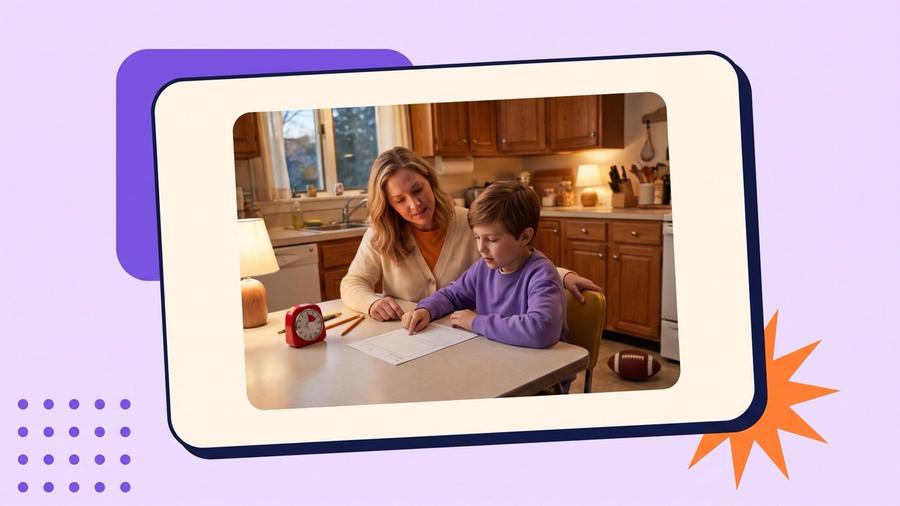
It is 16:40 at a kitchen table in Valby. A nine-year-old with ADHD has a maths sheet with 24 items, the pill he took at 07:30 has worn off, and his mother has 50 minutes before dinner. October is ADHD Awareness Month (ADHD Europe), and most of what a European parent finds when searching for ADHD homework strategies is written for American schools and American homework loads. The European evidence points somewhere else: less homework, better designed, and a routine that ends while it is still going well.
Homework helps on average, and the average hides the kids we are losing
The Education Endowment Foundation's Teaching and Learning Toolkit (review last updated August 2021) puts the average effect of homework at plus 5 months of progress, from 43 studies. Secondary homework scores plus 5 months, primary plus 3. The EEF rates the security of that evidence as low: most of the 43 studies were not randomised trials and many were not independently evaluated.
Two findings in the same review matter more for a child with ADHD than the headline number. Task quality counts for more than quantity, and there is some evidence that impact falls as time spent rises. The studies with the highest impact set homework twice a week in a subject, linked it to the lesson, and gave feedback on it (EEF, August 2021).
Denmark went further than most countries. In a survey by Epinion for the Ministry of Education, reported by Folkeskolen on 20 October 2017, 11 percent of Danish public schools said they had become fully homework-free, and another 42 percent had some classes or year groups without homework. VIVE's evaluation of the longer school day (January 2017) found that pupils at homework-free schools were typically glad to have fewer tasks, while some parents were frustrated at not being able to follow what their children were doing. Those numbers are nine years old and nobody has counted since.
I think a 24-item sheet for a nine-year-old with ADHD is the wrong tool, whatever the average says about homework. We wrote in March 2026 about why homework fails most kids. This post is about what a parent does at 16:40 with the sheet that arrived anyway.
The evening is the hardest hour, and the sheet makes it worse
A French trial protocol published in JMIR Research Protocols on 21 November 2024 (University of Nantes, 360 kids aged 9 to 16 with ADHD) calls homework sessions "frequent conflictual moments" with more anxiety in the kid and more stress in the parent. The trial is still running, so no result yet. The useful part is the description: the conflict is the norm, not a bad family.
Medication timing is part of it, and we will not give medical advice. We can say what the guideline says. NICE guideline NG87 (published 14 March 2018, last updated 13 September 2019) states that ADHD medication is only started by a specialist, and it recognises that stimulant effects wear off late in the day, for example when it advises extra snacks in the evening "when stimulant effects have worn off". It also tells clinicians to monitor sleep with a sleep diary. If your evenings collapse at the same time every day, write the times down and bring them to the next review.
The same guideline gives parents three things to put first: positive contact between parent and child, clear and consistent rules, and structure in the kid's day (NICE NG87, recommendation 1.4.9). It also names "environmental modifications", changes to seating, lighting and noise, as the first step. A 24-item sheet at a noisy kitchen table with a sibling on YouTube fails all three.
When I taught in the Danish public school system, the homework that came back from kids with ADHD was almost never the whole sheet. A kid who could name every squad in the Superliga but froze at item five. A kid who did the first four items perfectly and then guessed the rest in one colour. A kid who never brought the sheet home at all, because losing it was easier than failing it. We talk about that as a motivation problem, a parenting problem, a screen problem. It is a design problem. The sheet was built for 40 minutes. The kid had 10 good minutes. Not "will not finish". Cannot finish.
ADHD homework strategies: ten minutes, one task, stop early
The model below uses the EEF findings (short, linked to class, twice a week) and the NICE advice (structure, positive contact, changed environment). It has one rule: stop while it is going well.
Step 1. One task, agreed in advance. Before the kid sits down, pick one item type, for example the fraction questions, and say the number out loud: "four questions, then we stop". The rest goes back to the teacher unfinished, with a note.
Step 2. The child's interest is the context. Rewrite the four questions in the thing the kid already thinks about. For a football kid, four items about pizzas become four about a squad: "Eleven players, three are injured, what fraction can play?" Same maths, different reason to look at the page. If rewriting takes more than five minutes, keep the questions and change only the story.
Step 3. Timer visible, 10 minutes, no exceptions. A kitchen timer on the table, not a phone. When it rings, you stop, even mid-question, even if it is going well. Especially then. The kid leaves the table with the memory of a session that worked, and that memory is what gets him back tomorrow.
Step 4. One sentence of feedback, then done. Say what was right, specifically: "you found the denominator every time". Do not correct the wrong ones tonight. Put them on a sticky note for the teacher; feedback on homework is where the EEF review finds the highest impact.
Ten good minutes on four questions, stopped on time, beats forty bad minutes on twenty-four.
This is not a study result. It is a routine built from two guidelines and a classroom, and it fails on some evenings, usually because the task grew, the timer was ignored, or the correction came tonight instead of tomorrow.
What a parent can do
Five things for this week, with the time cost.
1. Write to the teacher and ask for fewer items with the same objective. One email, about 10 minutes once. The sentence that works: "Can he do the four questions that show he understands this week's goal, instead of all 24?" Most teachers say yes.
2. Fix the slot. The same 10 minutes every day, before the medication has fully worn off and before the kid is hungry. Ask the prescriber what time that is for your child. About 5 minutes to decide, then none.
3. Run the four steps above. 10 minutes an evening, three or four evenings a week, not five. The EEF's highest-impact studies set homework twice a week.
4. Keep a two-line log. Time started, how it went (one word), time the kid fell asleep. One minute an evening. After three weeks you have what NICE asks for at a medication review, and the teacher gets a picture instead of "homework is a battle".
5. Change the room before you change the kid. Same seat, back to the window, sibling elsewhere, no screen except the one the task is on. About 20 minutes once. This is the "environmental modification" NICE puts first.
If you forget the rest:
- Fewer items, same objective. Ask the teacher, in writing, this week.
- Ten minutes on a timer, and stop while it is going well.
- Log the evening in two lines and bring it to the next review.
Where GradeAid fits
GradeAid is a Danish platform for teachers. The teacher types in the topic and the level and gets a lesson plan, a worksheet, a quiz, a presentation and screen-free activities in seconds, which you can also differentiate. The material can be printed. Homeschooling parents use it the same way. The honest limit: 47.6 percent of worksheets made on GradeAid are edited after generation (our own data, 14 September 2026), and the routine above works just as well with a sheet the teacher wrote by hand.
If you work with kids with ADHD, in a special school, a municipality or at your own kitchen table, we would like to hear from you. Write to us at founders@gradeaid.ai.
Frequently asked questions
How long should homework take a child with ADHD?
Shorter than the sheet suggests. The EEF Toolkit (August 2021) found that homework quality matters more than quantity and that impact falls as time rises. For a child with ADHD, one task in a fixed 10-minute slot with a visible timer, stopped while it is still going well, gives more than a 40-minute struggle through every item. Ask the teacher for fewer items with the same learning objective.
Does homework actually help pupils with ADHD?
The evidence for homework in general is positive but weak: plus 5 months on average, plus 3 months in primary, with low evidence security (EEF, August 2021). There is no separate EEF figure for pupils with ADHD. A French trial of a digital homework support programme for 360 children with ADHD (JMIR Research Protocols, November 2024) is running but has not reported yet. Short, class-linked tasks with feedback are the best-supported design.
What can I ask my child's teacher to change about homework?
Ask for fewer items that cover the same objective, for example four questions on the week's goal instead of 24. Ask which items to prioritise if time runs out. Ask that unfinished items come back with a note rather than a penalty, since the EEF advises against homework as punishment. Put the request in writing so it survives a change of teacher. One email, about 10 minutes.
Should my child do homework before or after ADHD medication wears off?
That is a question for the prescriber, not a blog post. NICE guideline NG87 (2018, updated 2019) recognises that stimulant effects wear off later in the day and asks clinicians to monitor sleep and adjust medication. What a parent can do is log the start time and how the session went for three weeks, then bring that log to the next review so the timing decision is based on your child's pattern.
Are Danish schools homework-free?
Some are. In an Epinion survey for the Danish Ministry of Education reported by Folkeskolen on 20 October 2017, 11 percent of Danish public schools said they were fully homework-free and 42 percent had some homework-free classes or year groups. VIVE (January 2017) found pupils at those schools were typically glad, while some parents felt cut off from what their child was doing. No newer national count has been published.