Denmark's total phone ban: what the evidence really shows
AuthorFrederik Bjørnbak, Founder & CEO, GradeAid: former teacher in Denmark's public schools
10-second summary
On 10 September 2026 the Danish government announced a total ban on phones in public schools and after-school care, two days after PISA 2025 put Danish reading at 460 points, down from 489 in 2022. The UK SMART Schools study (1,227 pupils, February 2025) found no difference in wellbeing or attainment between schools with and without restrictions, while the Dutch national evaluation (July 2025) found 75 percent of secondary schools reporting better concentration. Our read is that a ban buys a quieter classroom but leaves four to six hours of daily screen time untouched. The post ends with five numbered steps for parents, with the time each one costs.
460. That is the reading score of Danish 15-year-olds in PISA 2025, down from 489 in 2022 (PISA 2025, published 8 September 2026). Two days after the number came out, Mette Frederiksen stood at a press conference and announced a total phone ban in schools across Denmark: lessons, breaks, public schools, free schools and after-school care. Here is what a ban changes, what it does not, and what a parent can do with the hours it does not touch.
Denmark now bans phones in breaks too, and has not set a date
The prime minister presented the plan with Education Minister Magnus Heunicke and the coalition party leaders. It bans phones and other smart devices for kids aged 6 to 16, in class and in the playground. Diabetes monitors and dyslexia tools are exempt (The Local Denmark, 10 September 2026). Heunicke said the restrictions "will be the new normal in Danish schools."
Alongside it, the government will put 1 billion kroner into next year's finance bill, most of it for the public schools, and it will open a tripartite process with teachers, school leaders, parents and kids (Folkeskolen, 10 September 2026).
None of this is new for most schools. On 30 September 2025 a broad majority in the Folketing agreed that every school board must adopt a local mobile-free policy for the school and the after-school care from the 2026/27 school year, with local exceptions and a web filter (Ministry of Children and Education, 30 September 2025). The difference on 10 September 2026 is that the local policy becomes a national rule, and breaks are now included. The government has not yet given a date for the law.
PISA 2025: a Danish 15-year-old reads like a 13-year-old did in 2015
PISA 2025 was published on 8 September 2026. Denmark's reading score fell to 460 points from 489 in 2022. Mathematics fell to 471 from 489. Science fell to 478 from 494 (The Local Denmark, 8 September 2026). The ministry's own translation: a 15-year-old in 2025 reads and calculates like a 13-year-old in 2015. Heunicke said: "We knew there were issues, but the extent of the issue is much larger than we ever thought."
The kids tested in spring 2025 sat the test before any national phone rule was in force. PISA shows the drop. It does not show how much of it phones caused. We talk about the result as a phone problem. It is a reading and maths problem that phones make worse. I think a total ban is the right call for the classroom and the wrong place to expect the PISA curve to move.
Phone ban in schools: what Denmark can expect from the UK and Dutch evidence
The UK SMART Schools study: no difference in wellbeing or grades
Researchers at the University of Birmingham compared 1,227 pupils aged 12 to 15 in 30 English secondary schools, 20 with restrictive phone rules and 10 with permissive ones (University of Birmingham, 5 February 2025, published in The Lancet Regional Health Europe). Pupils in the restrictive schools used phones about 40 minutes less during the school day. On wellbeing, anxiety, depression, sleep, behaviour and attainment in English and maths there was no difference. Total phone use was four to six hours a day in both. Lead author Dr Victoria Goodyear: "we need to do more than focus on schools alone."
The Dutch evaluation: calmer classrooms, especially in secondary
The Netherlands has had a national agreement on phones in class since January 2024. In the final monitoring report for the Dutch Ministry of Education, 75 percent of secondary schools reported better concentration, 59 percent a more social climate and 28 percent better academic results (Kohnstamm Instituut and Oberon, 3 July 2025). Primary schools reported far less change, because few younger kids brought a phone in the first place. Secondary teachers also reported more enforcement work.
Finland wrote its rule into law before Denmark did. Since 1 August 2025 kids in grades 1 to 9 may only use a device in a lesson with the teacher's permission, and a teacher may confiscate a device that disrupts learning (Finnish Government, 30 December 2024). Norway has had national recommendations for phone-free classrooms since February 2024.
Bans change the classroom, not the day
Put the two studies side by side. The classroom changed. The day did not.
Bans change the classroom. The Dutch schools report more concentration and more kids talking to each other. When I taught in a Danish public school, the difference between a lesson with phones in bags and a lesson with phones in pockets was visible from the door.
Bans do not change the day. The Birmingham study found the same four to six hours of daily phone use whether or not the school restricted phones, and no measurable gain in wellbeing or grades. A ban removes about 40 minutes from the school day. The rest moves home. A kid who hands the phone in at 8:00, gets it back at 14:00 and is on it until 22:00. A kid who does homework with a video running in the other window. A kid whose only structured screen time all week is the 90 minutes of gaming the parents negotiated.
Bans do not teach reading or maths. A quiet classroom is a condition for learning, not the learning itself. The 1 billion kroner and the tripartite talks will matter more for the next PISA round than the ban will.
A phone ban buys a quieter classroom; the other five hours of screen time are decided at the kitchen table.
- Expect calmer lessons, not higher test scores. That is what the Dutch (July 2025) and UK (February 2025) data support.
- Expect the least change in the youngest classes and the most in the oldest classes. Dutch primary schools saw little change; secondary schools saw the most, and the most enforcement work.
- Treat total screen time as the real number. The ban covers the school hours. The four to six hours a day in the Birmingham study are mostly outside them.
What a parent can do after 14:00
The school now owns the school day. You own the hours after 14:00. Five steps you can start this week, with the time each one costs.
1. Count the hours for one week (about 5 minutes, once). Open the phone's own screen-time report on Sunday evening. Write down the daily average and the three biggest time-users.
2. Set a fixed daily budget (about 20 minutes, once). Agree a number with the kid. For a 10 to 13-year-old a common starting point is 90 minutes of free screen time on school days, phone out of the bedroom from 21:00. Write it on the fridge.
3. Make part of the budget count (about 10 minutes a week). Offer a trade: 20 minutes of screen time spent on reading or maths practice earns 20 extra minutes of free use. Those are the two skills PISA 2025 says have slipped. A fractions game built around football or horses is still a game to an 11-year-old.
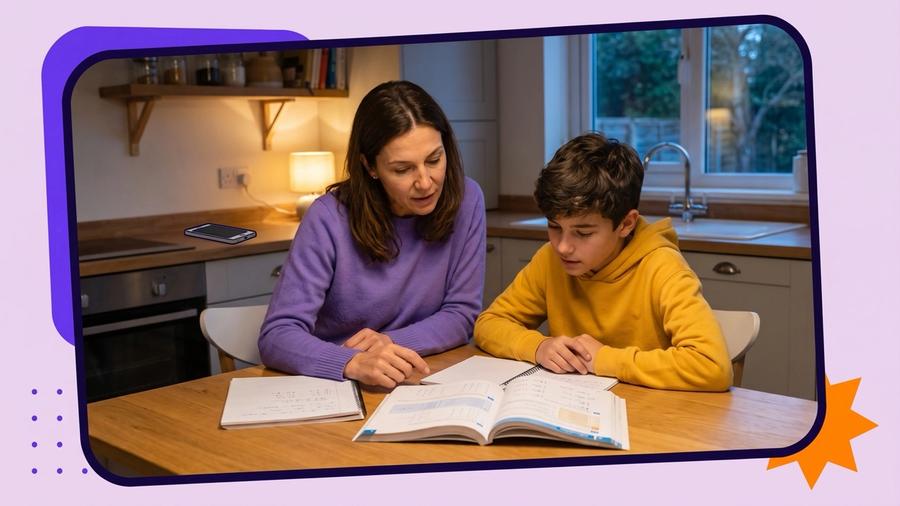
4. Move the phone, not the kid (0 minutes, every day). Homework is done at the kitchen table with the phone in another room. What matters is where the device is, not whether a rule exists.
5. Ask the school what it does with the calm (about 5 minutes at the next parent meeting). Ask one question: now that lessons are quieter, what extra reading or maths practice does the class get? A ban without a plan is half a policy.
Where GradeAid fits
GradeAid is a Danish platform for teachers. The teacher types in the topic and the level and gets a lesson plan, a worksheet, a quiz, a presentation and screen-free activities in seconds, which you can also differentiate. The material can be printed. Homeschooling parents use it the same way. GradeAid does not manage a kid's screen time; it gives the adult who plans the week material that matches the class's learning goals and the thing the kid cares about, and the worksheet is our weakest part (47.6 percent are edited after generation, our own data, 14 September 2026). Not a number we like, but it is ours.
If you work with kids, parents or a school that is preparing for the ban, we would like to hear from you. Write to us at founders@gradeaid.ai.
Frequently asked questions
Is Denmark banning mobile phones in all schools?
On 10 September 2026 the government announced a total ban on phones and other private screens in public schools, free schools and after-school care, in lessons and in breaks, for kids aged 6 to 16 (The Local Denmark, 10 September 2026). Upper secondary schools are not covered. Diabetes monitors and learning aids such as dyslexia tools remain allowed.
When does the Danish school phone ban start?
The agreement of 30 September 2025 already requires every school board to have a mobile-free policy in place from the 2026/27 school year (Ministry of Children and Education, 30 September 2025). The total ban announced on 10 September 2026 needs a law, and as of mid-September 2026 the government has not given a date for when the national rule replaces the local policies.
Do phone bans in schools improve test scores?
The evidence is mixed. The UK SMART Schools study of 1,227 pupils in 30 schools found no difference in English or maths attainment between restrictive and permissive schools (University of Birmingham, 5 February 2025). The Dutch national evaluation found 28 percent of secondary schools reporting better results and 75 percent better concentration (Kohnstamm Instituut and Oberon, 3 July 2025). Bans reliably buy calm; effects on grades are small or unproven.
Why did Denmark ban phones after the PISA results?
PISA 2025, published on 8 September 2026, gave Denmark its lowest scores ever: reading 460 (489 in 2022), maths 471 (489) and science 478 (494) (The Local Denmark, 8 September 2026). Two days later the government presented the ban, 1 billion kroner for schools and a tripartite process as its answer. PISA itself does not show how much of the drop phones caused.
Does a school phone ban reduce children's total screen time?
Not much, on the best data available. In the UK SMART Schools study, pupils in schools with restrictive rules used their phones about 40 minutes less during the school day, but total daily use was four to six hours in both groups (University of Birmingham, 5 February 2025). The hours after school are where a parent has the most influence, and where a written daily budget makes the biggest difference.