Homeschooling in Denmark: rules, supervision and numbers (2026)
AuthorFrederik Bjørnbak, Founder & CEO, GradeAid: former teacher in Denmark's public schools
10-second summary
A guide to homeschooling in Denmark written from Copenhagen for international families and Danish parents. It covers the legal basis in section 76 of the Danish constitution and chapter 8 of the Danish private schools act, the written notice to the municipality, and what municipal supervision looks like in practice, including how often it happens and when tests are used. It gives the 2025/26 numbers from Folkeskolen's survey of 90 municipalities and the reasons behind the growth, including school avoidance and neurodivergence. It ends with five numbered steps for a parent and a realistic weekly timetable.
2,560. That is how many kids Danish municipalities had in home education (in Danish, hjemmeundervisning) at the start of the 2025/26 school year, spread across 90 municipalities, according to a survey by the magazine Folkeskolen (26 September 2025). In 2015/16 the figure was about 400. Homeschooling in Denmark is still rare, but it has grown roughly six times in ten years. The questions we get from parents are the same three: is it legal, what does the municipality do, and what does a week look like. This is our answer, written from Copenhagen, for international families and Danish parents.
A duty to be taught, not a duty to attend school
The legal basis is one sentence in the constitution. Section 76 of the Danish constitution says that parents who themselves make sure their children get teaching that "can measure up to" what is generally required in Denmark's public schools are not obliged to send them to a public school. Denmark has a duty to be taught. It does not have a duty to attend school.
The practical rules sit in chapter 8 of the Danish private schools act. Paragraph 34 sets the notification duty. Paragraph 35 gives the municipality the supervision duty and the right to hold tests. The ministry's own page on home education lists the minimum subjects: Danish, maths, English, history and social studies, and the natural sciences.
"Measures up to" is the phrase everything turns on. It does not mean copying the public-school timetable. It means the child should be able to move on in the education system at the same level as a child who went to school. The municipality judges that, nobody else.
The letter to the municipality
You must notify the municipal council in writing before the teaching starts, not after. Paragraph 34 says the notice must state which children will be taught, where the teaching takes place and who will teach them. That is all the law requires.
In practice most municipalities have a form. Odense Municipality (page updated 27 November 2025) uses a MitID self-service form that asks for the child's details, the teacher's name and CPR number, and the address where the teaching happens. Smaller municipalities may accept an email to the school administration. Ask before you write.
Keep a dated copy. If the child is enrolled at a school, tell the school the same day, or it will keep registering absence.
What supervision looks like for homeschooling in Denmark
The municipality must supervise, but the law sets no frequency and no method. In the Folkeskolen survey of 90 municipalities (26 September 2025), 50 percent supervise once a year, 28 percent twice a year, 9 percent more often and 8 percent "as needed". Only 20 percent use tests. Within the last two years, 30 percent of the municipalities had found at least one case where the home teaching did not measure up to Denmark's public schools.
A typical first supervision visit, going by Odense's description, is a meeting arranged by a designated school. The supervisor asks to see material that shows the child's progress, a log of what has been taught in each subject, and a plan with interim goals for the coming period. The child is normally present. A test can be arranged as part of the visit.
Be clear about one thing: there is no public exam requirement. A home-educated child does not have to sit the public-school leaving exams in grade 9. But the municipality can require a test in any of the five minimum subjects, and 20 percent of them do. If the teaching is judged inadequate, the parents get written notice, a new test is held after three months, and if it still falls short the child must be enrolled in a school (the Danish Ministry of Children and Education).
Who is doing it, and why
The public story is a lifestyle choice: worldschooling, unschooling, long trips. The data is more mixed. In the Danish Agency for Education and Quality's survey of the municipalities, reported by Folkeskolen in September 2025, 67 percent of municipalities gave parents' pedagogical or political convictions as a reason, and 58 percent gave the child's poor wellbeing in a traditional school environment. Both are common. The second is growing.
The neurodivergence link shows up in another data set. In Autismeforeningen's survey of 1,405 parents (5 November 2025), 22.8 percent of autistic kids had been out of school for more than 12 months, up from 7 percent in 2016. 46.7 percent were in involuntary absence at the time of the survey. Not every one of those families ends up homeschooling. Enough do that Bornholm (138 kids), Svendborg (76) and Copenhagen (an estimated 300 this school year) now have supervision as a standing task.
We talk about homeschooling as if it is a parenting choice, a philosophy, a phone problem. For a growing group it is none of those. It is what is left when the school stopped working and no other placement was offered. A kid who reads two years ahead but cannot walk into a classroom with 26 others. A kid who has been on a waiting list for a special class since February. A kid who did fine until grade 5 and then stopped going. These are the families that call us.
I think the 20 percent test figure is the number to watch. Tests are not the enemy here. A yearly check that a kid in year 4 can actually read is the one thing that protects the kids who were pulled out for the wrong reasons.
What a realistic week looks like
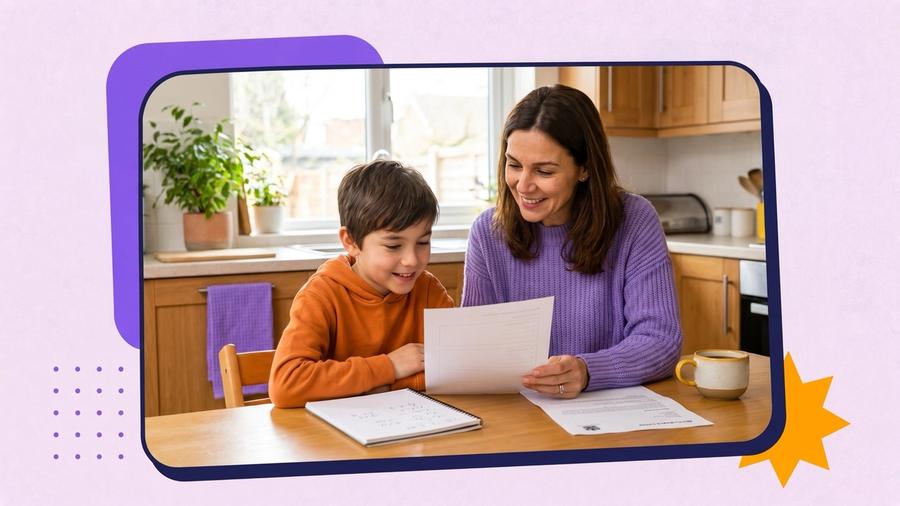
The kitchen table at 09:00, a nine-year-old, both parents working part time. Danish and maths every weekday, 30 to 45 minutes each, with a printed worksheet and a short talk about what was hard. English three times a week, mostly reading aloud and a game. History and science and technology as one project block on Tuesday and Thursday afternoons. Friday is the library, swimming and a meet-up with two other homeschooling families.
That is about 12 to 15 hours of structured teaching, less than a public-school week. That is fine, because the standard is what the child can do, not hours sat. What is not optional is the log. Ten minutes at the end of each day, noting what was covered in which subject, is the document the supervisor asks for first.
Homeschooling in Denmark is legal, rare and growing fast, and the municipality's supervision is the one part of it you cannot opt out of.
What a parent can do
1. Contact the municipality first. Call the school administration and ask two questions: who handles supervision of home education, and is there a form. About 15 minutes.
2. Send the letter before you start. Include the child's name and CPR, the address where the teaching happens, and the name of the person teaching. Use the municipality's form if it has one. Send it, keep a dated copy, and tell the current school the same day. About 20 minutes.
3. Write the plan. One page per subject for the five minimum subjects, with two or three goals per term and the materials you will use. Write it against the Danish curriculum for the child's year group. About 3 hours once, then an hour at the start of each term.
4. Keep the log. A notebook or a spreadsheet: date, subject, what was done, what was hard. 10 minutes a day. This is the single document that decides how the first supervision visit goes.
5. Prepare the first supervision visit. Bring the log, the plan and five samples of the child's work per subject. Ask up front whether the municipality tests, in which subjects and when. If the child has a diagnosis or a history of school avoidance, say so; a supervisor who knows why the child is at home makes a fairer judgement.
Where GradeAid fits
GradeAid is a Danish platform for teachers. The teacher types in the topic and the level and gets a lesson plan, a worksheet, a quiz, a presentation and screen-free activities in seconds, which you can also differentiate. The material can be printed. Homeschooling parents use it the same way. GradeAid does not write your letter, keep your log or replace the supervision; it produces the week's material against the Danish curriculum, and the plan stays yours.
If you work with kids in home education, at home, in a municipal supervision team or at a special school, we would like to hear from you. Write to us at founders@gradeaid.ai.
Frequently asked questions
Is homeschooling legal in Denmark?
Yes. Section 76 of the Danish constitution gives parents the right to teach their children themselves, as long as the teaching measures up to what Denmark's public schools generally require. Denmark has a duty to be taught, not a duty to attend school. The detailed rules are in chapter 8 of the Danish private schools act, and the municipality where the child lives supervises the teaching.
How do I notify the municipality that I want to home-educate?
You must tell the municipal council in writing before the teaching starts. The notice must say which children will be taught, where the teaching takes place and who will teach them. Many municipalities, including Odense, use a MitID self-service form; others accept an email to the school administration. Keep a dated copy and inform the child's current school the same day.
How often does the municipality check on home-schooled children?
The law sets no frequency. In Folkeskolen's survey of 90 municipalities (September 2025), half supervise once a year, 28 percent twice a year, 9 percent more often and 8 percent as needed. Only 20 percent use tests. A typical visit covers a log of what has been taught, samples of the child's work and a plan with goals for the next period.
Do home-schooled children in Denmark have to take exams?
No. There is no requirement to sit the public-school leaving exams in grade 9. However, the municipality can hold tests in Danish, maths, English, history and social studies, and the natural sciences as part of its supervision. If the teaching is judged inadequate, parents get written notice, a new test is held after three months, and if it still falls short the child must be enrolled in a school.
How many children are home-educated in Denmark?
About 2,560 at the start of the 2025/26 school year, across 90 municipalities, according to Folkeskolen's survey (26 September 2025). That is roughly six times the figure from 2015/16, which was about 400. The numbers vary a lot: one child in Glostrup, 138 on Bornholm, and an estimated 300 in Copenhagen. It is still well under one percent of all school-age children.